

Tegucigalpa, Honduras – On September 20, the first migrant caravan of the year left Honduras for the United States, carrying between 200 and 400 migrants north towards the U.S. border.
Despite the White House’s harsh anti-migrant policy – marked by mass deportations and detentions – citizens of the Central American nation continue to aim for the U.S., fleeing violence and socioeconomic hardship at home.
Now, experts say a new factor could increase the number of Hondurans heading north: the El Niño weather pattern.
With the migrant caravan growing to more than 600 as citizens of Guatemala, El Salvador, Ecuador and Haiti join, Washington’s Embassy in Honduras has responded by issuing warnings discouraging them from travelling towards the U.S.
President Donald Trump has overseen a record-number of deportations, with Hondurans making up the third largest group of deportees.
While it seems likely that Washington’s tough border policies are having some deterrent effect, Cesar Castillo of the Migration Observatory at the National Autonomous University of Honduras (UNAH), doubts that this will stop Hondurans from moving altogether. “It is clear that those who migrate do so because they have no other options than to do so.”
One factor driving people to leave is the high level of violence. Honduras remains the country with the third highest homicide rate of Latin America and the Caribbean.
The rising cost of living has added another point of pressure. For three consecutive weeks, Hondurans in major cities have protested rising prices and expressed anger with the government. Hessler Ruiz, one of the protesters, says the cost of basic goods and gasoline has become so high that he is considering whether he should build a future elsewhere. “It seems hopeless to stay in Honduras,” he told Latin America Reports.
But there is another factor shaping migration patterns for Hondurans: the drought caused by this year’s super El Niño. According to the World Food Programme, Central America’s Dry Corridor, which includes Honduras, Guatemala, El Salvador and Nicaragua, is one of the regions most at risk of severe food insecurity from this year’s El Niño.
In Honduras, the government has placed 80% of the country, or around 1.8 million people, under a red alert because of the extreme drought.
The communities in Choluteca, in the south of the country, are feeling these effects. They have not been able to harvest, wells have dried up and there are no fish to catch anymore.
Eugenio Uma, a farmer and local community leader, explains how “along the road, you’ll find piles of dead cattle lying in the heat, because people have to decide whether to feed themselves or their animals.”
Uma worries that the worst is still to come. So far, his community has been able to rely on food reserves, but these will run out at one point.
COPECO, Honduras’ disaster management agency, is planning for the worst period of the drought to hit in October and November, its director of preparedness and response, Oscar Mencia, told Latin America Reports.
“The main impact of this humanitarian crisis,” says Darlin Alvarez, from ASONOG, an NGO that operates across Honduras, “will be migration.”
Alvarez explains that climate-induced migration fits a different pattern than those of fleeing violence.
“The processes are slower. Migrants might arrive in a major city and live there for a few months or years. But, as they are typically more economically and socially vulnerable, this can prompt them to decide to leave Honduras altogether,” she told Latin America Reports.
Merciodes Zepeda Mendez, a farmer from Concepción de María in Choluteca, has already been displaced. He has had to move to El Triunfo, another town in the region, and take up work in construction. And while he would like to move out of the country, he says it is not an option. Whereas a journey that used to cost between US$8,000 and $10,000, it now costs $15,000 to $18,000.
“Only those who can afford to migrate. The rest of us are stuck, stuck with the drought.”
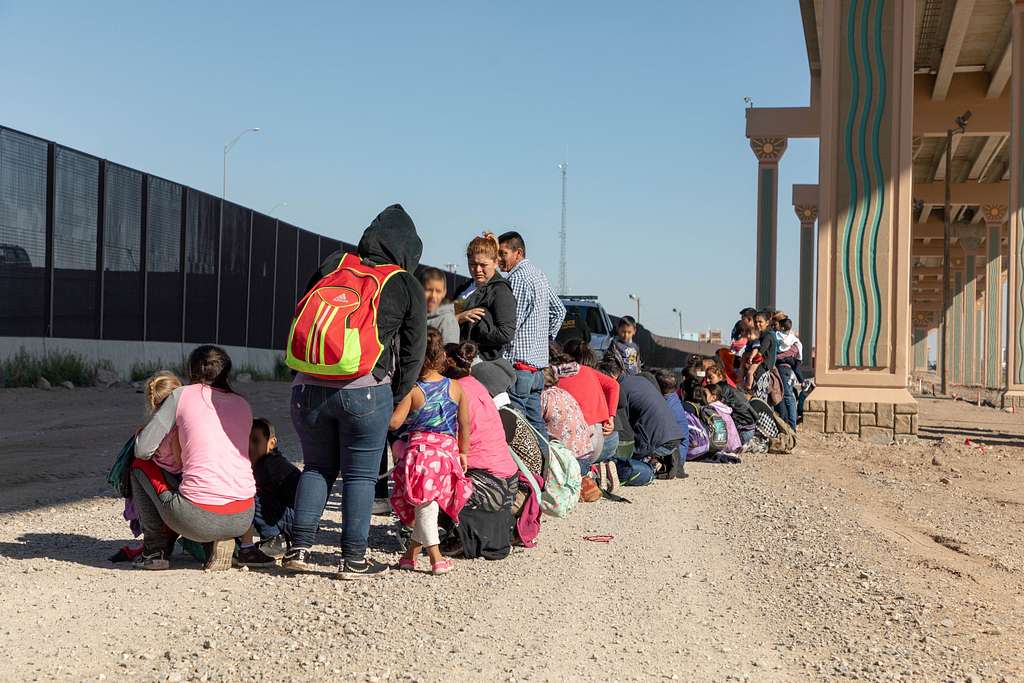
Featured image description: Migrants who crossed the border illegally surrender near El Paso, Texas.
Featured image credit: Mani Albrecht via NARA.