
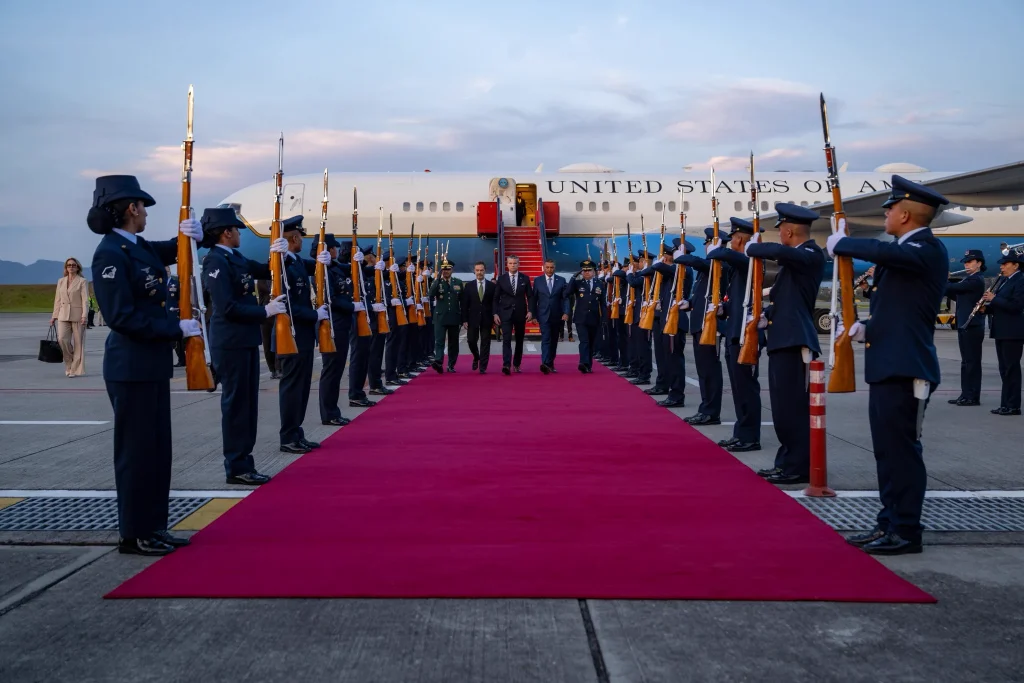
Caracas, Venezuela — U.S. Secretary of War Pete Hegseth made a surprise visit to Venezuela on Wednesday, where he announced a new military cooperation agreement, ten months after the U.S. operation to capture Nicolás Maduro.
The agreement is intended to re-establish military cooperation between the two countries, including training for Venezuela’s armed forces, intelligence sharing and access to new technologies for the Venezuelan military. It was signed by Hegseth and Venezuela’s Defense Minister, Gustavo González López.
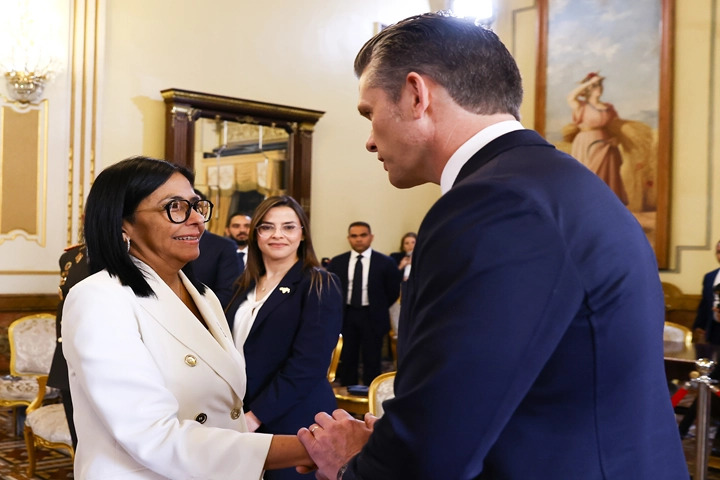
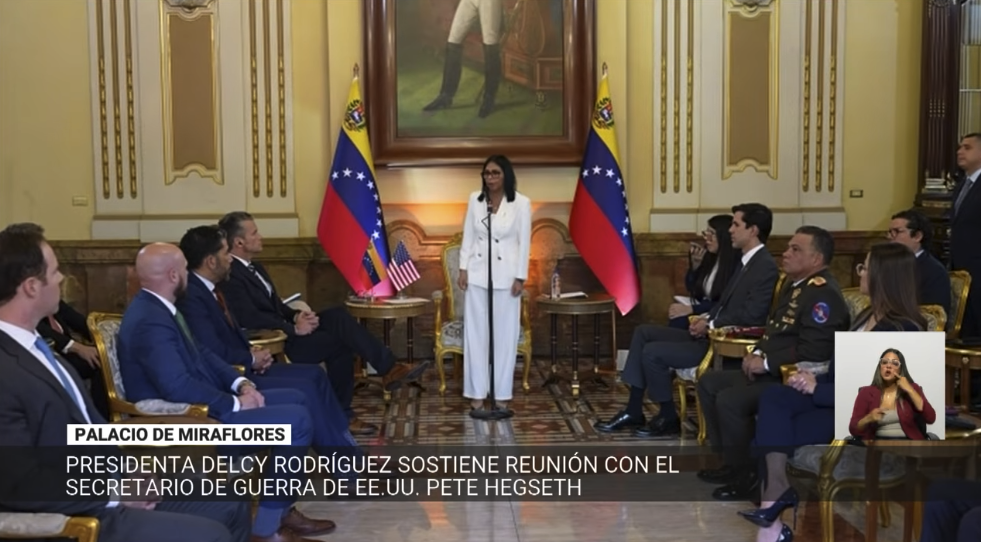
Hesgeth met interim President Delcy Rodríguez at the Miraflores presidential palace in Caracas. He described Venezuela as having gone from “our most aggressive regional threat to a compliant security partner”, praising Rodríguez’s cooperation.
U.S. forces have continued strikes against boats they say are carrying drugs in the Caribbean and eastern Pacific. At least 240 people have been killed since the campaign began in September 2025, according to the Associated Press, although U.S. officials have released little public evidence to support claims that the targeted vessels were carrying drugs.
Rodríguez, Maduro’s former vice-president, said that Venezuela had experienced “very difficult and painful moments”, but that bilateral relations were improving.
“Thanks to the political and geopolitical maturity of our governments, we have turned them into an extraordinary space for cooperation and mutual benefit between our countries,” she said.
At a news conference at the U.S. embassy afterwards, Hegseth recalled how Maduro had taunted Washington a year earlier, telling it to “come and get me”.
“Well, we answered that call,” he said.
Hegseth was among the senior U.S. officials overseeing the operation to capture Maduro on January 3, in which he was taken to a New York jail. Dozens of Venezuelan and Cuban soldiers were killed.
Phil Gunson, Senior Analyst at the International Crisis Group, said Hegseth’s visit and his public mockery of Maduro’s capture must be deeply humiliating for the Venezuelan military, whose morale had already suffered two major blows in the first half of the year.
“First they were unable to defend the nation’s borders or their own commander-in-chief, and then they proved themselves almost completely useless when it came to earthquake relief efforts,” he said, referring to criticism of the military’s response following the twin earthquakes on June 24.
Gunson said the message of the visit was that the military was now “completely subordinate to the Pentagon”, despite the language of cooperation and partnership.
He said the visit raises questions about U.S motives. The Trump administration, he told Latin America Reports, appears to want to “make a partner out of the same armed forces that they accused of being up to their eyes in all sorts of illicit activity, including drug trafficking, not to mention complicity with Colombian guerrillas and other armed groups.”
While an overhaul of the security forces in general is needed for a viable political transition in Venezuela, he says it remains unclear what Washington envisages.
For the Venezuelan armed forces, he says the agreement raises questions about how they will reconcile their longstanding anti-imperialist rhetoric with a new relationship with Washington.
“They have undergone a whiplash-inducing, 180-degree turn from leftist anti-imperialism to alignment with the very government that until 3 January was their sworn enemy,” Gunson said.
But some analysts say the shift may not be as difficult for the military establishment as it first appears.
Orlando Pérez, a political analyst specializing in Venezuela, said that under Chavismo, the operating doctrine of the Bolivarian National Armed Forces (FANB) had been survival.
“Anti-imperialist rhetoric worked as a loyalty test that tied officers to Chávez and then Maduro and branded any dissent as treason. Since January 3, the guarantor of that survival sits in Washington,” he said.
“Officers who kept their commands and their businesses after Maduro’s capture have every reason to accommodate the power that allowed it.”
On the U.S. side, he said its assistance to Venezuela could drive real reform if it came with conditions of depoliticizing the armed forces and strengthening civilian control. “Without them, Washington gets a FANB better able to dominate civilians, and any elected government will have to live within the limits that the military sets.”
No text of the agreement has yet been made public.
At the meeting at Miraflores, Rodríguez was accompanied by Defense Minister González López and Oliver Blanco, Venezuela’s recently appointed foreign minister, who is not from the ruling PSUV party.
Businessman Alejandro Betancourt, whose company North American Blue Energy Partners is involved in a recent multi-billion-dollar agreement with the U.S., was also present. He has been under investigation in Spain and Switzerland over alleged money laundering and tax fraud, but has not been charged or convicted.
The military agreement is the latest step in a wider U.S. role in Venezuela since Maduro’s removal. Senior Trump administration officials have visited to discuss the country’s oil reserves and critical minerals, while Washington has been working with Rodríguez’s government on energy arrangements.
Rodríguez continues to lead the country following Maduro’s capture, but no date has been set for a new presidential election. Opposition leader María Corina Machado has recently returned from exile, after a series of failed attempts to get back into Venezuela.
Featured image: U.S. Secretary of War Pete Hegseth shaking hands with Venezuela’s interim President Delcy Rodríguez on November 18, 2026 during a surprise visit by Hegseth to Caracas.
Image credit: Venezuela state media