
In an unexpected move, the Cuban Foreign Ministry announced on Thursday night that the Cuban government would release 51 prisoners in the coming days “in the spirit of goodwill”.
According to the Cuban government the decision, described as “sovereign” in the statement, was taken as a result of its “close relationship” with the Vatican, suggesting that the Holy See had a significant part to play in the prisoner release.
The prisoner release comes amidst severe tensions between Cuba and the U.S. as Washington continues its campaign of economic pressure to try to force regime change on the island.
Although the Cuban government denies that its decisions are influenced by U.S. economic pressure, the release could be a sign of its willingness to make concessions in order to de-escalate tensions with Washington, which often criticizes its arbitrary detention of political prisoners.
The Cuban government did not specify who it would release, but said that the prisoners selected “have all served a significant part of their sentence and have maintained good conduct in prison”.
This is not the first time that Havana has released prisoners to soften relations with Washington. In early 2025 the Cuban government granted over 500 prisoners early release in accordance with the terms of a deal between the Miguel Díaz-Canel and Joe Biden administrations.
In return, Biden removed Cuba from the U.S. list of state sponsors of terrorism just days before his term ended. Cuba was, however, redesignated a state sponsor of terrorism immediately after Donald Trump came to power; the prisoners were released regardless.
The 2025 deal was also brokered by the Vatican, highlighting the traditional importance of the papal state as a mediator between the two nations.
The Vatican appears to have adopted this role of interlocutor again, as Vatican Secretary of State Cardinal Parolin stated earlier this week that the “necessary steps” had been taken to ensure a “negotiated solution” between the two adversaries.
In the context of current tensions, Pope Leo XIV called for Cuba and the U.S. to engage in “sincere dialogue” to “avoid violence” in early February and recently held talks with Cuban Foreign Minister Bruno Rodríguez Parrilla.
The top U.S. diplomat in Cuba – Chief of Mission Mike Hammer – also met with a representative of the Holy See to discuss the “deteriorating situation in Cuba”.
Read more: Cuba, U.S. reportedly “talking” as Pope calls for de-escalation of tensions
“Historically, [the Vatican’s role] has been important because in Cuba the Catholic Church has remained a presence more than in most other communist countries, certainly more than in [Soviet] Russia,” Professor Massimo Faggioli, a professor of ecclesiology at Trinity College Dublin and a Vatican specialist, told Latin America Reports
Although that “history of coexistence” has been “difficult” – religious celebrations were once banned on the island and the Cuban Communist Party seized Church property after coming to power – the Church’s continued existence in Cuba has meant that “all popes since John Paul II have had some kind of relationship with the Cuban leadership, to the dismay of the Americans”.
That relationship has become more important as the Vatican now, according to the Professor, perceives “a clearer threat” on the part of the United States “to do something about Cuba” and its communist regime in the wake of the Venezuelan and Iranian operations.
The Vatican’s “traditional approach to international relations … based on multilateralism, on the role of international organizations, on the rule of law” means that the Holy See finds itself “at odds” with the current American policy of potentially destabilizing unilateral regime change operations. This, in turn, has led it to push “to prevent the escalation” of the U.S.-Cuba tensions into a military conflict, Faggioli argued.
The Vatican has historically been successful in mediating difficult negotiations between adversaries, the ecclesiologist pointed out, because their representatives engage in diplomacy as a “service to the Church” borne from faith and therefore tend to be less career-oriented.
Furthermore, the Vatican’s experience in mediating conflicts worldwide means “there is a treasure of knowledge and of relationships and of connections” within the papal diplomatic corps, which operates “in every part of the world”.
Although Faggioli suggested that some senior figures in the American administration – such as the Catholic Marco Rubio and Trump himself – may not be the most amenable to the Vatican’s overtures, he also recognized that “there are some voices in the U.S. Department of State that are more cautious than … [those] in the cabinet of Donald Trump” and might represent “different views when they talk with the Vatican”.
With today’s official confirmation of ongoing Cuba-U.S. negotiations by Cuban President Miguel Díaz-Canel, perhaps the Vatican will be called upon to act as intermediary between the two adversaries once again.
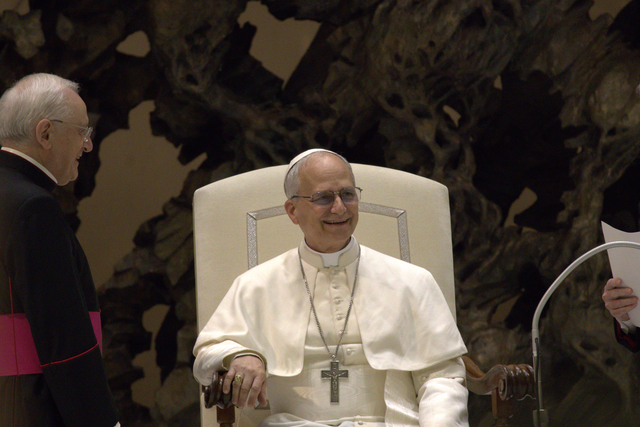
Featured Image: The current Pope Leo XIV. He is the first American-born Pope and has called for de-escalation between his country of birth and Cuba.
Image Credit: Edgar Beltrán via Wikimedia Commons
License: Creative Commons Licenses