

Caracas, Venezuela — Astrid Méndez was recovering at Domingo Luciani Hospital in Caracas from injuries she sustained in Venezuela’s June 24 earthquakes.
She spent nearly a day trapped under the rubble of her apartment building in Caribe, La Guaira, alongside her mother and two children. She is one survivor of the worst natural disaster to strike Venezuela in recent memory, one which has left 5,300 people dead, according to government figures.
“A column from the apartment fell on my hip. I curled up in a fetal position; that put pressure on me and fractured my pelvis,” she told Latin America Reports from a hospital bed on July 17.
She explained that when she was rescued by family members and firefighters who pulled her out from beneath the rubble, she felt something terribly wrong with her body.
“I was screaming in pain.”
Initially, Méndez was taken to the Venezuelan Social Security Institute’s Macuto facility in La Guaira. She was stabilized and later taken to Domingo Luciani Hospital, where she has already undergone two surgeries.
“They put a brace on my pelvis, and the following week they operated on me again and inserted screws. I’m here recovering.”
Astrid must spend three months without putting her feet on the floor, and although the doctors have discharged her, she is desperate because she has nowhere to go.
For her, a shelter is not an option, as she does not consider it suitable to live in such a place given her condition.
“I have nowhere to go,” she said while lying in her hospital bed.
Regarding the conditions at the hospital, Astrid noted that she has been treated well by the staff, but civil society has also helped through nongovernmental organizations or citizens who have made donations to support her with essentials like food, since the health center only guarantees one meal a day.
“Many people from outside come to help,” she acknowledged.
Her brother, Liscano Méndez, said that his sister will need a walker when she’s able to use her legs again.
He explained that she cannot be moved to another location.
“She was discharged, but since we have nowhere to take her—because we were affected by the disaster—we have nothing: no clothes, nothing. But we want to stay here until she can at least walk.”
Her brother explained that the relatives who could take her in live in a neighborhood on a hill, which complicates the situation. “How are we supposed to get her up there? This is very delicate—it’s her pelvis.”
“We’d rather stay here, no matter what. We have to fight through this,” Liscano added.

Astrid’s Grief
During the rescue, neighbors and first responders managed to save Méndez and her two children, but her 62-year-old mother, Yaremis, died under the wreckage — a tragedy that causes Méndez deep grief.
She said she worked with her mother at a food stand they ran on the beach. On the day of the quakes, after returning from work, they went up to the apartment and spent some time together.
Later, while they were at home, her son Moisés received an earthquake alert. In a panic, she told her mother and her two children, Moisés and Ashley, to run to the kitchen.
The building began to collapse, and fear gripped them. “That sound was like a monster,” Méndez recalled through tears.
After regaining her composure and realizing they were trapped, Méndez noticed that her mother was beside her, but she was moaning in pain.
As the hours passed, however, she realized her mother had succumbed to her injuries.
Méndez remembered her mother as a cheerful woman who had expressed her love for her entire family.
Once she recovers, Méndez plans to visit her mother’s grave to say the final goodbye that she hasn’t been able to give due to her injuries.
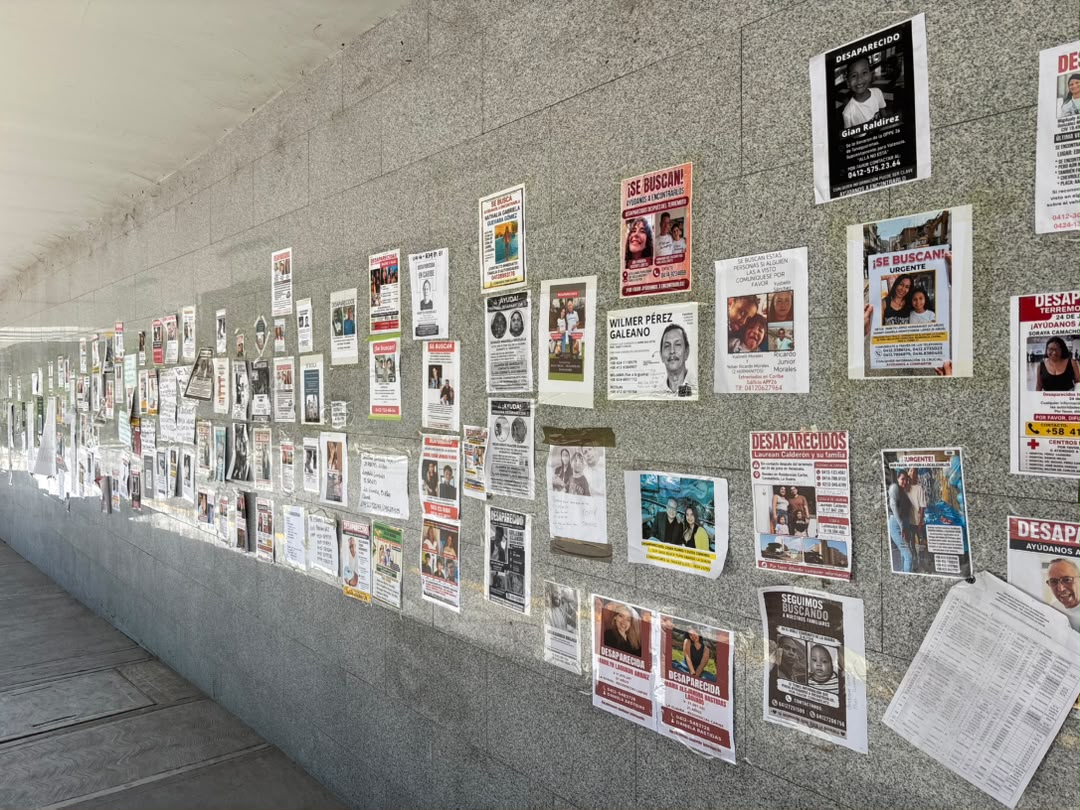
Featured image: Wall filled with posters of missing relatives following the earthquakes in Venezuela on June 24.
Image credit: Julio Blanca for Latin America Reports.