
The U.S. State Department announced a further package of sanctions against the Cuban government on Thursday, with various Cuban companies associated with the military and nickel mining targeted.
On the same day, the European Parliament adopted a resolution calling on the EU to suspend its Political Dialogue and Cooperation Agreement (PDCA) with Cuba and sanction figures associated with the regime, citing their complicity in human rights abuses.
This increasing international pressure comes as Cuba faces a worsening humanitarian crisis, with food, fuel and electricity shortages becoming more commonplace as the island’s sanctions-hit economy struggles to cope.
“Communist Cuba is a corrupt failed state and a persistent threat to U.S. national security … The United States will keep exposing and sanctioning those who sustain this system”, U.S. Secretary of State Marco Rubio posted on X.
Along with various military research and nickel mining companies, the U.S. sanctioned three high-ranking members of the Cuban Revolutionary Armed Forces (FAR).
The measures come weeks after Cuban Foreign Minister Bruno Rodríguez Parrilla revealed that Cuba and the U.S. are no longer engaged in bilateral negotiations designed to end the tensions between Washington and Havana.
The Cuban economy is already struggling under the weight of comprehensive restrictions of oil imports to the island by the U.S., as well as secondary U.S. sanctions against the nation’s security, energy, defense and financial services sectors.
However, relations between Cuba and the EU have historically been more cordial; the two entities signed the PDCA in 2016 to normalize bilateral relations and promote political and economic cooperation.
The EU has also provided the nation with millions of euros worth of humanitarian aid since the early 1990s.
This agreement, however, has come under increasing scrutiny this year.
In January, the right-wing European Conservatives and Reformists (ECR) parliamentary faction tabled an amendment to the European Parliament’s foreign policy report to include a call to suspend the PDCA. The amendment was approved.
Thursday’s European parliamentary resolution on Cuba, which passed by 374 votes in favor to 198 votes against, also urged an immediate suspension of the PDCA because of an alleged increase in human rights abuses by the Cuban government.
In particular, the proponents of the resolution pointed to the cases of Félix and Saylí Navarro, two Cuban dissidents who were arrested during the 2021 anti-government protests on the island and sentenced to several years in jail.
Human Rights Group Amnesty International considers both the Navarros “prisoners of conscience.” The group’s 2025/2026 human rights report also details the continuation of arbitrary detention and repression of peaceful freedom of expression by the Cuban authorities.
Polish MEP Arkadiusz Mularczyk, a member of the ECR and one of the authors of the January amendment, backed yesterday’s resolution.
“The European Union must terminate its agreement with Cuba. It is time to end support for the communist regime that imprisons opposition members and violates basic human rights”, Mularczyk told Latin America Reports.
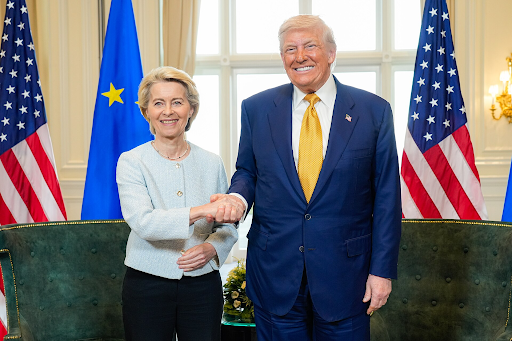
Featured Image: President of the European Commission Ursula von der Leyen and U.S. President Donald Trump meeting in July 2025.
Image Credit: Fred Guerdin via Wikimedia Commons
License: Creative Commons Licenses