
This article was originally published by Erick Espinosa on The Bogotá Post and was republished with permission.
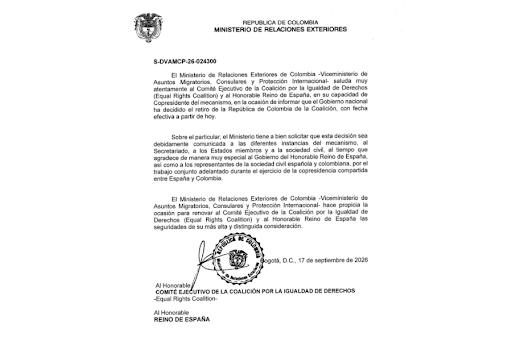
Medellín, Colombia — Colombia withdrew from the Equal Rights Coalition on September 17, ending its participation in the largest intergovernmental alliance dedicated to LGBTIQ+ rights.
The country’s foreign ministry confirmed the exit in a letter issued by the vice-ministry of migratory, consular and international protection affairs and addressed to the coalition’s executive committee and its co-chair, the Kingdom of Spain.
What was in the letter?
The letter thanked Spain and civil-society organizations for their work during the shared co-chairmanship, but did not provide a reason for the country’s decision to exit.
According to Spanish newspaper El País, Vice-Minister Pedro Roa shared in a virtual meeting that the alliance “is not a priority” for the government and that Colombia’s membership was “something from the previous government”, a reference to former President Gustavo Petro, under whom the country joined the coalition.
The coalition, founded in 2016, groups roughly 40 member states, working on a mixture of diplomacy, legislation, public policy, and humanitarian protection initiatives.
The work is designed to be completed by leadership that rotates every two years, with co-chairmanship shared between two member states and two civil-society organizations.
Colombia and Spain have held the state seats since 2025, with the Colombian organization Caribe Afirmativo representing civil society.
Is “not a priority” the same as walking away?
The government has framed the exit as a balance of priorities. But according to Daniel Bonilla, academic director of the Global Future School of Fundación Universitaria CEIPA, based in Sabaneta, Colombia, the framing is misleading.
“The response is depoliticizing a decision that is inherently political,” Bonilla told The Bogotá Post, pointing to the difference between dropping something and rejecting it.
“Colombia actively withdrew from a role it had voluntarily assumed and was performing, mid-term, with a formal diplomatic note,” adding that the “not a priority” language is a way to avoid a real explanation. Arguing that the government gets what it wants, out of the coalition, without publicly admitting it sees promoting LGBTQ rights abroad as something not worth doing.
“Most of the administration’s LGBTQ-related signals so far have come through appointments rather than direct executive acts,” said the geopolitical professor, “making this withdrawal notable as one of the few decisions taken directly by the executive with no intermediary, abandoning what is described as a significant space of diplomacy.”
Does it change anything for LGBTIQ + Colombians?
The coalition is a voluntary group, not a treaty passed by Congress or tested at the Constitutional Court. It leaves untouched court rulings related to same-sex marriage, adoption and protection from discrimination.
In response to their decision, the vice-minister of migratory, consular and international protection affairs, Pedro Agustin Roa, explained that:
“Colombia’s withdrawal from the coalition for equal rights does not in any way signify a setback in terms of rights for the LGBTIQ+ population,” pointing to Colombia’s “very robust framework of rights protected by the Political Constitution, public policies, and a series of regulations, as well as rulings from the Constitutional Court that protect minorities based on sexual orientation.”
Bonilla believes that a symbolic retreat matters less for what it changes today than for what it makes normal tomorrow, “Whether this becomes consequential in practice will depend on what follows it, not on the withdrawal itself.”
The reaction
Caribe Afirmativo stated they were not consulted prior to the announcement. Wilson Castaneda, the organization’s director, said it was the clearest decision the government had taken against LGBTI rights and warned it left Colombia poorly positioned internationally.
The national ombudsperson, Iris Marin, rejected the decision on social media and called on the Foreign Ministry to clarify that leaving the coalition did not distance the state from its duty to protect one of the country’s most marginalized groups.
“Human rights do not belong to any ideology, party or political expression,” said Marin, arguing the state’s obligation to protect them should not be politicized, citing 68 killings of trans women recorded by the attorney general’s office between 2024 and April 2026, and 148 killings of LGBTIQ+ people reported by the forensic institute in 2025, warning that “discrimination becomes violence.”
The wider context
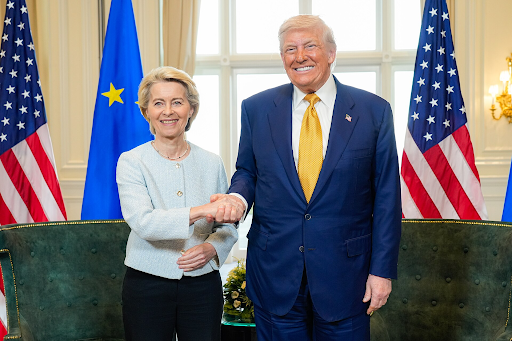
Colombia’s new President Abelardo de la Espriella, a conservative lawyer endorsed by U.S. President Donald Trump, won June’s presidential election by less than one percentage point. During the campaign, he defended the “traditional family”, sharing that a child needs a father and mother, while promising he would respect Constitutional Court rulings.
Set against those comments, Bonilla sees the withdrawal as part of something larger. It “looks less like an isolated foreign policy tweak and more like the international expression of a domestic project,” he said.
One built around what the government “explicitly calls a cultural battle.” He places it alongside other shifts: the government “has pursued closer alignment with the Trump administration in Washington and restored ties with Israel,” which he calls “a wider reorientation of Colombia’s international posture, not only on rights issues.”
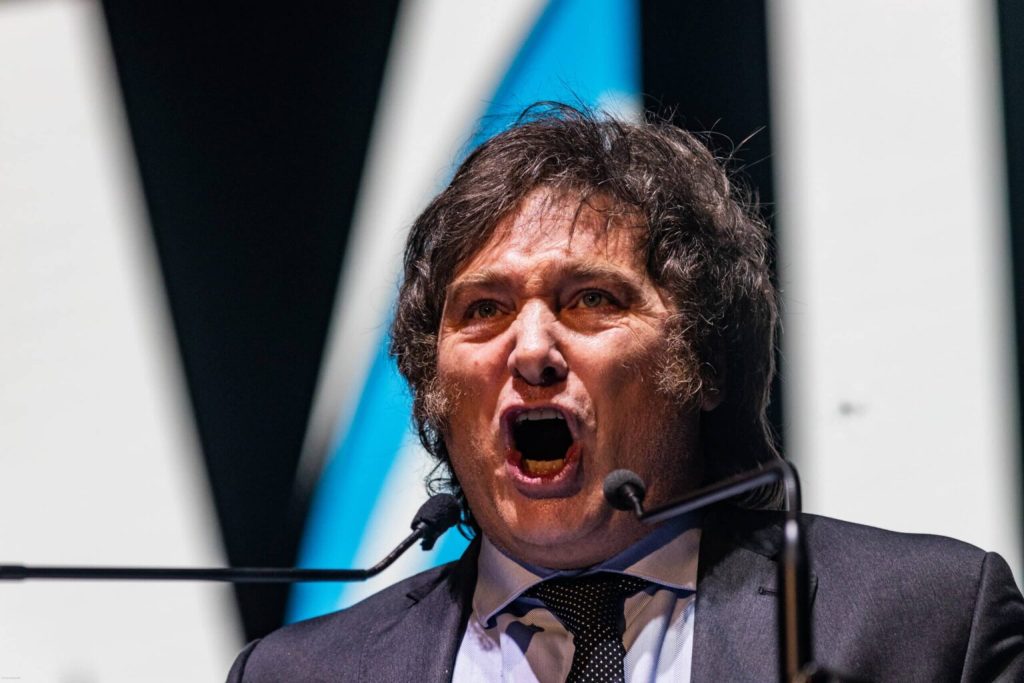
“Colombia’s move is unlikely by itself to trigger a regional cascade, but it fits a pattern that is already visible,” he said, pointing to “Argentina under [Javier] Milei and El Salvador under [ Nayib] Bukele,” both “skeptical of multilateral gender and rights frameworks.”
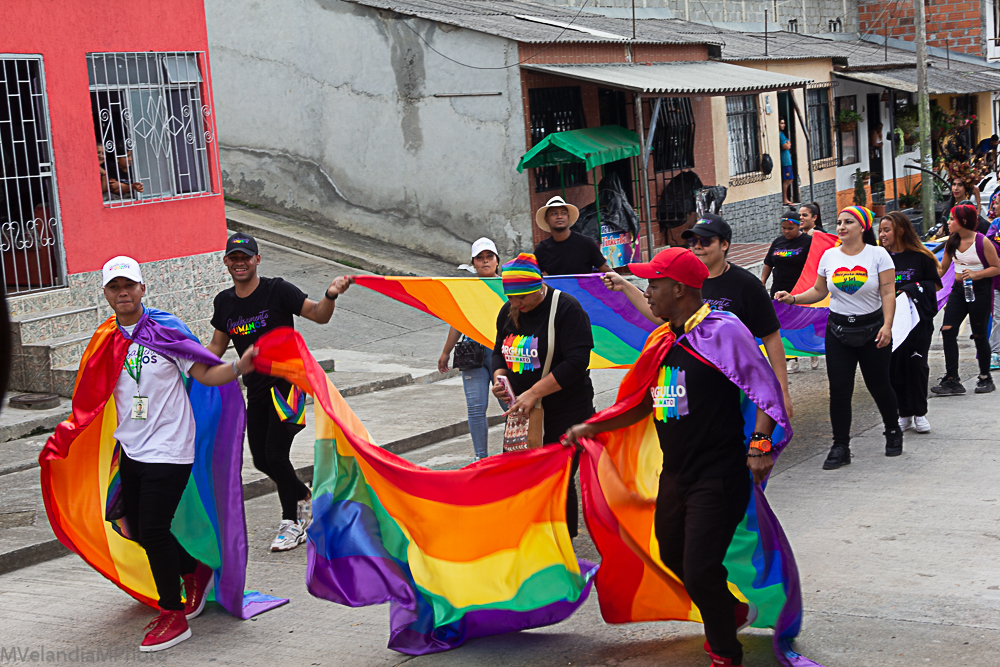
Featured image credit: Manuel Velandia via El Centro Nacional de Memoria Histórica (CNMH)
This article was originally published by Erick Espinosa on The Bogotá Post and was republished with permission.