
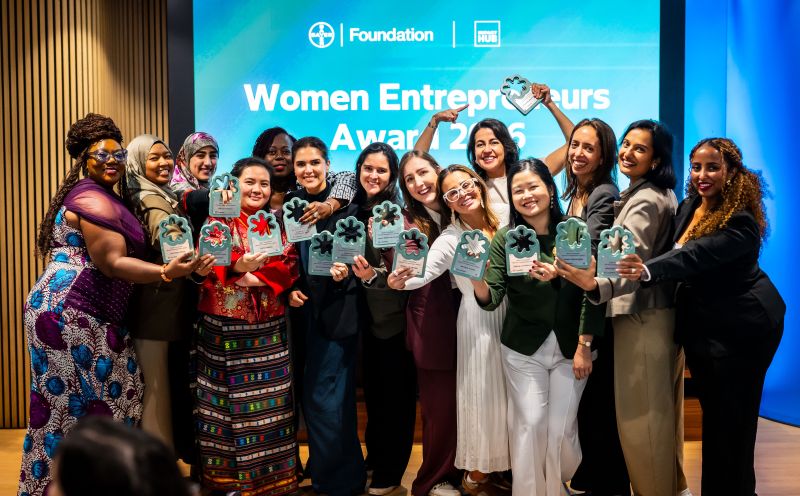

Three Colombian women building health technology for patients far from the country’s specialists are among the 15 winners of the 2026 Bayer Foundation Women Entrepreneurs Award.
The prize comes with €25,000 ($27,500 USD) in non-dilutive funding and six months of acceleration with the Impact Hub network.
Ximena Ruget, María Artunduaga, and Valentina Agudelo were picked from 1,172 applications across 124 countries, and honored in Amsterdam last month. The 15 winners came five each from Africa, Asia, and Latin America.
Their companies take on different problems, and are all rooted in the lacking access to healthcare that has come to characterize Latin American countries.
Ruget’s Glya monitors chronic patients at home through connected devices and WhatsApp, and has flagged more than 56,000 health alerts across 1,400 patients. Artunduaga, a physician, built Samay’s chest patch to measure lung function without a hospital visit. And Agudelo’s Salva Health has used its portable device, Julieta, to screen more than 8,000 women for breast cancer risk, many of whom live in towns where a mammogram is hours away.
In 2024, female-only founding teams received just 2.3% of global venture capital, or $6.7 billion of $289 billion, marking the Bayer prize an important leap for investment into innovation and technology.
All three women are also selling into a system that can barely pay its bills.
“The EPSs are in a very complicated situation right now,” Agudelo said of Colombia’s health insurers in particular. “Saying they have money problems is putting it mildly.”
An award for the Global South
The Bayer Foundation directs the award at low and middle-income countries. This year’s winners come from Brazil, Colombia, Nigeria, Kenya, Tanzania, Morocco, Indonesia, India and Bhutan.
The countries share a common problem, with the World Health Organization (WHO) projecting a shortfall of 11.1 million health workers by 2030, mostly in low and lower-middle income countries.
Colombia is a clear example. According to OECD data, the country had just 0.6 specialist doctors per 1,000 people in 2023, against an OECD average of 2.6. Most of them work in Bogotá, Medellín and Cali, the country’s primary urban centers, leaving the countryside and rural areas largely understaffed.
All three Colombian winners built their products to work without those specialists nearby.
Salva Health’s Julieta runs without internet or a power outlet, and needs no specialist to operate. In Maicao, La Guajira, near the country’s northern border with Venezuela, the company tested 3,000 women in 30 days, and the device flagged 42 of them; all 42 got a mammogram.
“The health system no longer has to worry about 3,000 women, but about 42,” Agudelo told Latin America Reports.
Samay’s Sylvee, named after Artunduaga’s grandmother, Sylvia, who died of complications from chronic obstructive pulmonary disease (COPD), sends sound into the chest and reads how the lungs resonate. The idea is to bring hospital-grade lung testing into the home.
“There are no technologies that help you understand what’s happening in the lung, so you’re waiting for the patient to tell you how they feel,” Artunduaga said.
Glya avoids asking older patients to learn a new app. Its device sends readings from a glucometer or blood pressure cuff on its own, and patients comfortable with their phones can send a photo of the reading on WhatsApp to Glady, Glya’s AI assistant.
“We didn’t want to depend on the patient’s digital skills,” Ruget stressed.
What the prize pays for
Latin American healthtech is growing, but from a small base. Investment in the region’s healthtech startups rose 36.6% in 2024 to $253.3 million, a fraction of what fintech, for example, attracts.
For Glya, the money buys time. Public institutions want proof before they sign, so pilots have to be funded before any revenue comes in.
“This kind of grant lets us run those free trials and cover them financially until the agreements start billing,” Ruget said.
Samay is running clinical trials in Medellin and building revenue with pharmaceutical companies while it waits on regulators. It has opened talks with Invima, the Colombian Institute for Food and Drug Surveillance, and expects to launch Sylvee in Colombia in early 2028, then expand to Chile and, later, Mexico and Brazil.
“Samay wants to become the Nubank of deep tech in Colombia and Latin America,” Artunduaga said.
For Agudelo, however, the Bayer name is the game changer. “Objectively, we’ve seen much more return in the connections, the impact and the strength of having Bayer as an ally than in what we can do with the 25,000,” she explained.
Salva already operates in Guatemala and is opening in Venezuela. Hearing the other winners’ stories in Amsterdam made her think beyond the region.
“Everything we see in Colombia is 50 times smaller than what you see in Bangladesh,” she added. “It’s the same problem, but a billion people have it.”
Building for a system in debt
Selling in Colombia means selling into a crisis. As of June 2026, the EPSs owed clinics and hospitals $27.8 trillion Colombian pesos ($7.7 billion USD). Insurers under government intervention hold 65.7% of that debt.
The regional stakes are higher still. The Pan American Health Organization estimates that noncommunicable diseases and mental health conditions will cost South America more than $7.3 trillion between 2020 and 2050, roughly the annual GDP of the whole of Latin America and the Caribbean.
Each founder has found a different way to get paid until the insurers recover. “The most important thing is understanding the payment, who pays and who gives me my reimbursement code,” Artunduaga said. “You start from the end and work backwards.”
For Samay, pharma is the bridge for now. Glya sells to private insurers, healthcare providers and public primary care centers.
Salva Health’s screening programs, meanwhile, are funded by mayors’ offices and health secretariats, and run through public hospitals that women already trust. Employers pay for screening days, too.
Agudelo believes prevention will eventually win the argument with insurers. “It will always be cheaper to have a woman who never had to go through chemotherapy because we caught it in time,” she said.
This article was originally published by Salomé Beyer Vélez on The Bogotá Post and was re-published with permission.
Featured image: Salva Health via LinkedIn