

Medellín, Colombia – When a 7.4-magnitude earthquake struck Colombia on August 10, the country was still watching its neighbor, Venezuela, recover from twin earthquakes measuring 7.2 and 7.5 that struck on June 24.
Today, over two months after Colombia’s earthquake and four months after Venezuela’s, the two nations are confronting the long-term consequences of the disasters, with the focus moving past immediate rescue efforts towards housing, infrastructure, services, and reconstruction.
But despite their geographical proximity, the two nations’ disparate paths to recovery and reconstruction highlight fundamental underlying differences, according to experts.
Venezuela: a strained disaster response
Compared to Colombia’s quake, which killed at least 331 people, the toll of Venezuela’s was roughly 20 times greater, claiming the lives of at least 6,509 people – though the figure is believed to be much higher. The scale of material destruction was also much vaster.
“The situation in Venezuela could not be more dire and serious, and there is virtually no response, transition, or path toward reconstruction,” said Omar-Darío Cardona, a Colombian civil engineer, academic and disaster-risk expert.
According to Cardona, demolition of damaged buildings and debris removal are underway, but funding and resources remain minimal. U.S. humanitarian assistance, he added, is limited to those residing in temporary shelters, leaving significant questions about whether sufficient resources will be available to support thousands of people’s return to stable housing conditions.
Due to the extent of the earthquake, the longer-term consequences extend beyond specific matters of housing. Damaged commercial areas, public services, and infrastructure can prevent businesses from reopening and residents from covering the costs of their living expenses.
For families and individuals already facing displacement, prolonged reconstruction can mean losing not only their homes but also the economic networks that made their communities viable.
Colombia: roadblocks to recovery
Colombia’s recovery presents a differing set of challenges. Although the government effectively mobilized national and international rescuers following the disaster, the transition toward permanent housing solutions and reconstruction has revealed gaps between immediate assistance and the longer-term needs of affected communities.
Cardona explained that the government allocated temporary rental assistance to families who lost their residences, but the support was designed to last only three months. For people whose homes require extensive repairs or complete reconstruction, that period may be insufficient to establish a stable living situation.
Temporary aid has the capacity to provide an essential bridge between displacement and recovery, but without a clear path toward permanent housing, families risk remaining dependent on short-term arrangements while waiting for damaged properties to be repaired or rebuilt.
“It is also important to consider that in Colombia, the earthquake response has been more effective in cities, but very inadequate in smaller communities,” said Cardona.
Rural sectors affected by armed conflict face particular challenges in the recovery process. In parts of the Pacific region, for instance, the disaster compounded longstanding barriers to public services, while difficult terrain, damaged infrastructure and the presence of armed groups have made sustained assistance and reconstruction harder to deliver.
For this reason, as rebuilding progresses in urban areas, these rural communities risk facing a longer wait for permanent housing, restored livelihoods and the essential services needed to recuperate from the damage.
Institutional capacity: why the responses differ
The differences between the countries’ long term responses are closely tied to their institutional structures and levels of disaster preparedness.
“In Venezuela, the absence of functioning institutions is the fundamental reason why little is being done for affected communities and territories. Colombia has greater institutional coordination in its response efforts,” claimed Cardona.
Colombia, he argued, has a relative advantage through its disaster-risk management system and its decentralized political, administrative, and fiscal structure. These give departmental and municipal governments defined responsibilities and ultimately provide a framework for coordinating post-emergency action across distinct levels of government.
In Venezuela, he continued, the national disaster-risk management system no longer operates as it did more than a decade ago, leaving affected communities without the institutional structures needed to coordinate proper assistance.
These factors help explain the contrasting responses, but neither country is free from faults. Cardona warns that to this day, though to distinct extents, disaster-risk management remains insufficiently integrated into political decision-making in both Colombia and Venezuela, contributing to inadequate preparedness on a local level.
“In both countries, local readiness to earthquakes remain seriously deficient, despite the fact that this is where the help should begin rather than depending on assistance from elsewhere.”

Building vulnerability: the cost of unsafe construction
The extent of earthquake damage and recovery cannot be understood through institutional differences alone.
Construction quality and compliance with building regulations also influence the extent of damage and the challenge of disaster relief. According to Cardona, though the two countries have modern seismic-resistant design standards, that does not mean they are strictly enforced.
“Institutions are key when it comes to building permits, and in this regard, Colombia is stronger than Venezuela in terms of its cities. But, in smaller communities, noncompliance with regulations is a serious problem in both countries, and informality has been the rule. For this reason, most buildings do not comply with seismic-resistant standards.”
Buildings erected before current geological considerations, informal construction without adequate engineering, and poor-quality structures increase the extent of damage during a major earthquake. Even buildings designed under earlier rulings may be insufficiently equipped to withstand the particular demands of modern natural events.
“Vulnerability has been high, and in Venezuela there were many cases where seismic demands, driven by pulses of energy, exceeded the capacity of structures to withstand them,” Cadona maintains.
These weaknesses in construction oversight may compound Venezuela’s broader recovery challenges. Where building regulations are poorly enforced and institutional capacity is limited, authorities face the dual task of replacing damaged housing and addressing the structural vulnerabilities that made buildings susceptible to collapse in the first place.
Safe reconstruction requires not only funding and building materials, but also engineers, reliable inspections, effective permit systems, and the capacity to enforce construction standards. Years of brain drain mean shortages in these areas threaten to delay reconstruction efforts and increase their costs.
Colombia faces similar obstacles, particularly in smaller municipalities where inconsistent guidelines remain widespread. However, Cardona’s assessment suggests that stronger institutional oversight in some cities provides a comparatively better foundation for ensuring that reconstruction meets safety standards.
The long road to recovery
“There is a complete disconnect between the response and recovery efforts in both countries,” said Cardona.
A key step towards the transition from emergency aid to effective recovery, he argued, is conducting detailed damage assessments alongside a census of affected residents.
Authorities need to determine which homes can be repaired, which require structural reinforcement, and which must be reconstructed. They must also evaluate damage to public services and local infrastructure.
“Significant financial resources are needed in both cases, but they are not available,” Cardona explained.
He criticized Colombia’s reliance on donations from the private sector to finance recovery, arguing that this overlooks the state’s fiscal responsibility.
Venezuela, meanwhile, faces an even more fundamental challenge, one consisting of substantial reconstruction needs alongside major economic problems and highly weakened institutions. Although the international assessment estimated recovery needs of up to US$21 billion, the figure represents what is required, not a guarantee that the funding will be secured.
Beyond financing, recovery plans must reflect the needs of individual territories. The challenges facing a large city may differ substantially from those affecting a small municipality, particularly where local economies depend on tourism, commerce, agriculture, or industry.
“The impacts can vary greatly between large cities and smaller municipalities, and even from one part of a city to another. Unless these differences are properly recognized and addressed, reconstruction and recovery will be either slow or nonexistent,” said Cardona.
Colombia’s preliminary recovery plan represents a step toward organizing that process, but according to Cardona, visible progress in both countries will require sustained investment and clear accountability for delivering results.
There are also opportunities for cooperation. Both Colombia and Venezuela have engineers, universities, professional associations, and researchers with expertise in seismic engineering, risk assessment, and safer construction.
Exchanging technical knowledge, sharing assessment methods, and strengthening cooperation between specialists, Cardona asserts, could help the neighboring nations improve preparedness and reduce future risks. Expertise alone, nonetheless, cannot replace political commitment or adequate financing.
Ultimately, the measure of recovery will not be the number of plans announced or buildings repaired. It will be whether displaced families regain safe, permanent housing; whether essential services and livelihoods are restored; and whether communities and institutions emerge better prepared for future natural disasters.
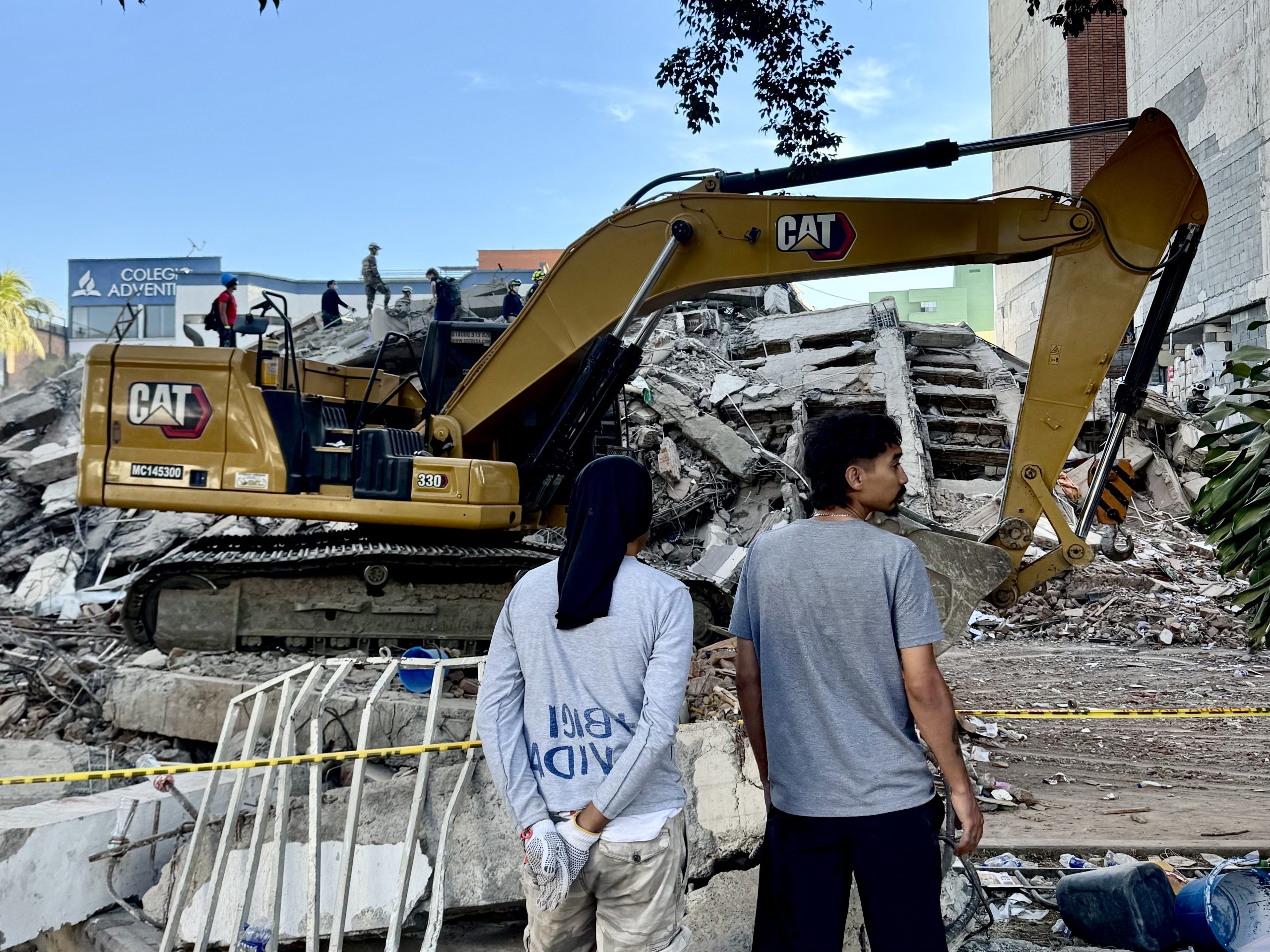
Featured image description: Onlookers at the site of the collapsed Vanessa Building in Cali after the 2026 earthquake.
Featured image credit: Alfie Pannell.