
Russia’s state-funded broadcaster RT has begun broadcasting on free-to-air television in Nicaragua, extending Moscow’s ties with the country’s authoritarian government and reach in Central America.
On 28 September 2026, Nicaragua’s co-president Rosario Murillo announced that RT en Español had begun broadcasting free-to-air on UHF channel 31, describing it as the “first stage” of the rollout and saying RT would progressively expand coverage over the coming months until it reached all of Nicaragua.
The agreement comes as Murillo and her husband, Daniel Ortega, cement their authoritarian rule in the country and suppress dissent, including the free press.
At last year’s St Petersburg International Economic Forum, RT en Español director Victoria Vorontsova and Nicaragua’s Communication and Citizenship Council media coordinator Daniel Edmundo Ortega Murillo signed an agreement aimed specially at getting RT onto Nicaragua’s free-to-air television.
The agreement is now being implemented, though the Nicaraguan government has not publicly detailed the licensing arrangement, ownership of the frequency, infrastructure or financing behind it.
Russia is not the only major power expanding its media presence in Nicaragua. China has steadily deepened ties with the country’s broadcasters since Managua restored diplomatic relations with Beijing in 2021, supplying television programming and developing training and exchange programmes with Sandinista-aligned media.
Daniel Edmundo Ortega Murillo, the presidential couple’s son who signed the 2025 agreement paving the way for RT’s free-to-air broadcasts, has also played a central role in those Chinese media agreements.
The ties remain active in 2026. A delegation from China Media Group’s Spanish-language CGTN arrived in Nicaragua on September 23 for meetings with Nicaraguan communicators and to produce reports on relations between the two countries. This occurred just days before the government announced RT’s terrestrial television rollout.
Nicaragua offers unusually favourable conditions for this kind of media expansion. The Ortega-Murillo government has developed close political relationships with both Russia and China, while the space for independent domestic media has contracted sharply.
Reporters Without Borders (RSF) says most independent outlets have been shut down, confiscated or forced into exile, while several major television and radio outlets are controlled by the Ortega-Murillo family or government. Nicaragua ranks 168th of 180 countries in RSF’s 2026 press-freedom index.
Russia’s involvement in the Nicaraguan media scene predates Channel 31. An RSF investigation documents agreements between Nicaraguan media officials and Sputnik in 2022 and RT in 2022, followed by training, equipment, exchanges and content-sharing, with RT establishing a physical presence in Managua by 2023.
However, going free-to-air in Nicaragua means RT will be placed alongside ordinary domestic television channels rather than interested citizens having to seek out RT en Español online or subscribe to cable to view its broadcasts. If the promised rollout reaches all of Nicaragua’s departments, RT will gain a greater foothold in Nicaragua’s information environment.
For now, Moscow has something Beijing does not: a dedicated place on Nicaragua’s terrestrial television dial. But with Chinese state media steadily expanding their relationships with the country’s broadcasters, Channel 31 may not be the last new foreign presence on Nicaragua’s airwaves.
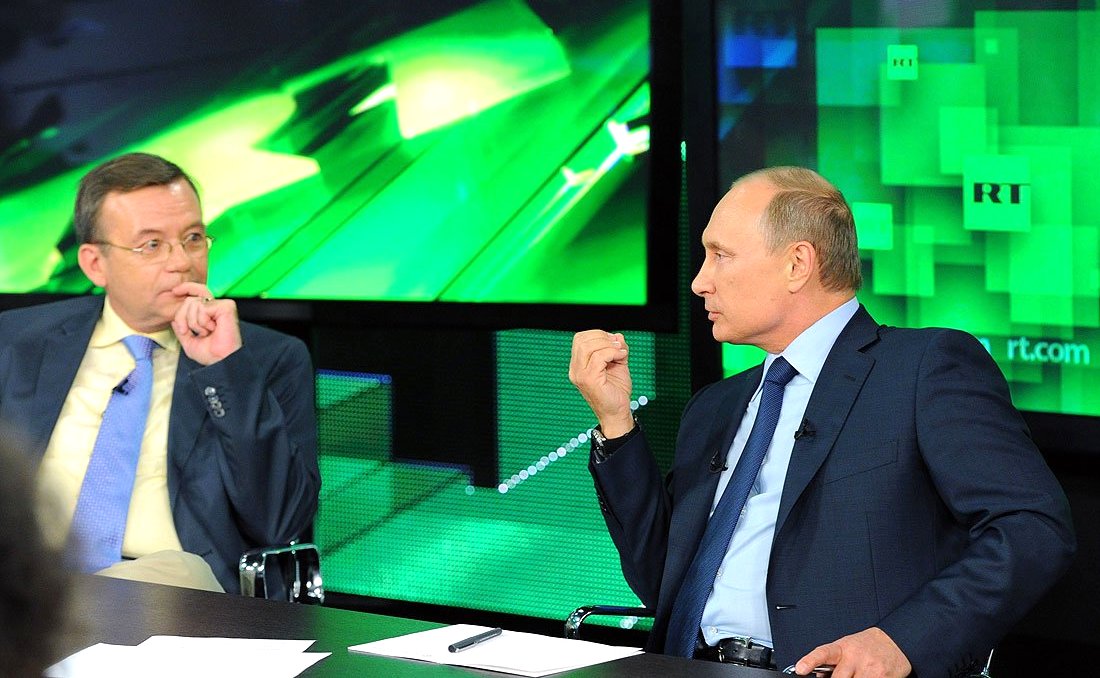
Featured image description: Vladimir Putin visited the new Russia Today broadcasting centre and met with the channel’s leadership and correspondents in 2013.
Featured image credit: Kremlin.ru via Wikimedia Commons.