
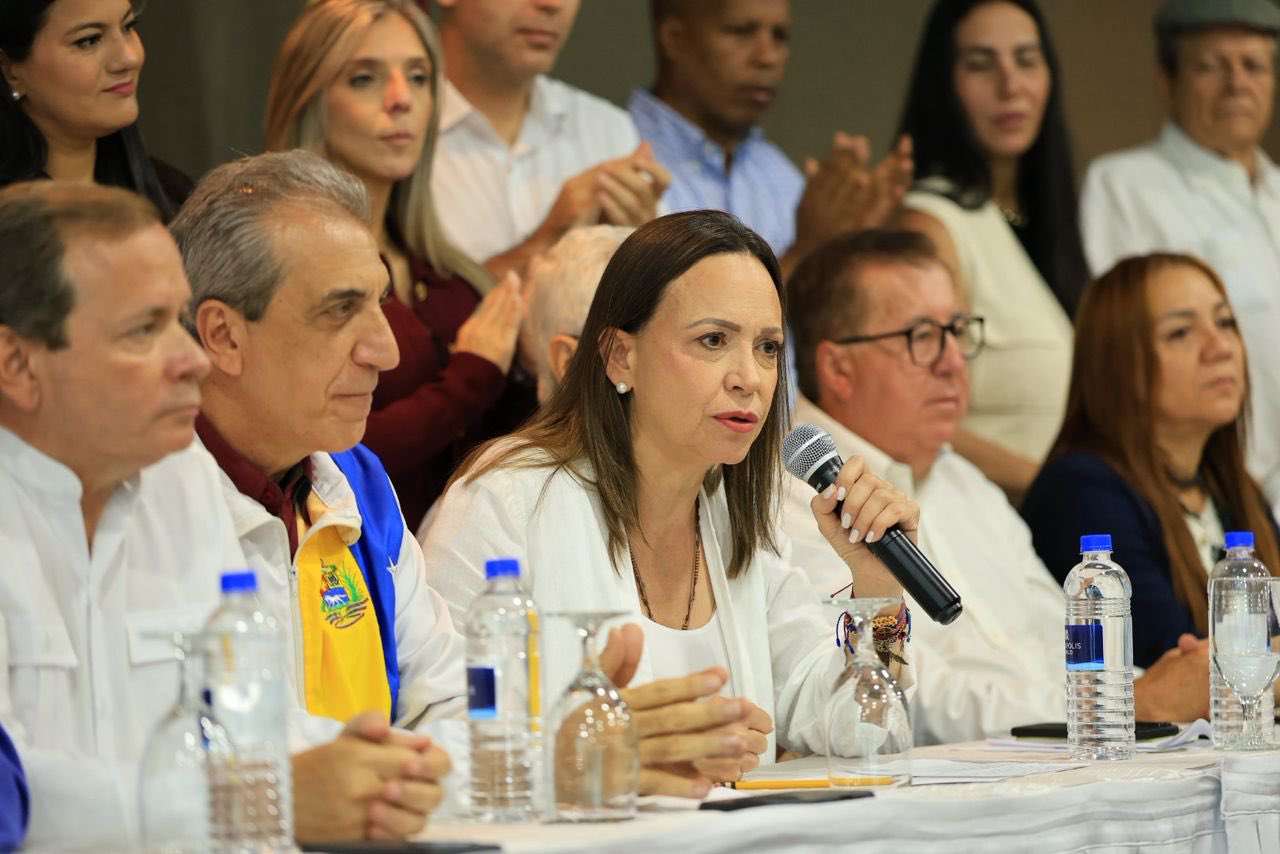
Caracas, Venezuela — Venezuela’s opposition members — many of whom are in exile after years of political persecution — agreed in late May in Panama City on a new roadmap to address the current situation in the country, six months after Nicolás Maduro’s capture by U.S. special forces.
In an effort to establish concrete actions that could bring about political change in the country, members of the opposition Democratic Unitary Platform, Maria Corina Machado’s Vente Venezuela movement, and other prominent figures, agreed to negotiate with Delcy Rodríguez’s government while also calling for new elections and the liberation of political prisoners.
“We express our determination to promote serious, firm, and responsible political negotiations with the interim regime to restore democracy in Venezuela with the support of the U.S. government,” states their Panama Manifesto.
While the opposition is showing a united front that’s willing to negotiate, some analysts say the manifesto fails to address some big challenges in what could be a years-long process of political transition.
Oswaldo Ramírez, a Venezuelan political risk consultant based in Miami, told Latin America Reports that the opposition’s decision is part of a strategic shift focusing on three key elements:
The first is attempting to maintain legitimacy after disputed elections in 2024 in which their stand-in candidate Edmundo González lost to Maduro in what the opposition and independent observers alike called fraudulent elections.
Secondly, according to Ramírez, the opposition needs to retain the trust of its traditional supporters while also building trust with Venezuelans who have not historically aligned with their cause but nonetheless believe now is time for political change in the country.
Finally, he noted that with their manifesto, the opposition aims to re-engage with Donald Trump’s three-phase plan for economic and political stability and transition in Venezuela, which, to this moment, has effectively sidelined opposition leader Maria Corina Machado.
A new round of negotiations
Ramírez said that Machado has shifted her rhetoric toward negotiation with the interim government because she has come to understand that the country has entered a very different phase.
“The path to Venezuela’s reconstruction is not an easy one because it could take up to a decade—something the public has not yet fully grasped,” he said, referring to the process the nation could undergo if an agreement is reached between the government and the opposition.
Ramírez believes that the current situation spans many areas, from the economy to the importance of civil society regaining greater power over various freedoms that have been curtailed in recent years.
He said the Venezuelan citizenry has high expectations for the current “honeymoon” phase between the U.S. and Venezuelan government, but assured that Venezuelans’ patience will run out if they do not see concrete results.
“The public is hopeful, with positive expectations, but this is not a blank check,” he emphasized.
Political scientist and director of media outlet Polianalítica, Jesús Medina Molleda, opined that the manifesto does not truly include all factions of the opposition, something he views as a serious issue for the upcoming processes the country may undergo.
We must also understand, he told Latin America Reports, that many opposition figures aspire to political office and “some will be upset because they never left the country and weathered the entire process, while others simply left the country and now want to return to take the positions of those who stayed behind.”
This division between politicians who remained in Venezuela and those who went abroad “creates an internal conflict that, if they fail to fully understand and acknowledge one another, could lead to future divisions.”
Medina Molleda’s main criticism of the manifesto is that it focuses too much on the opposition’s needs, and not enough on ordinary citizens.
“This is a political document serving political interests, but it has nothing to do with the agenda of Venezuelans who will become future voters when the elections come,” he said.
He added that Venezuelans’ main concern is the economy, and perhaps that is one of the document’s weaknesses.
“It’s a good start to showcase an opposition that is uniting, but they need to keep working to understand that there are more factions within the opposition than they realize,” he concluded.
Featured image: Maria Corina Machado at the presentation of the Panama Manifesto.
Image credit: El Comando Con Venezuela via X.