
Medellín, Colombia – The U.S. government announced on Wednesday that it was delivering on its promise to deliver $3 million in much-needed disaster relief to the Cuban people affected by Hurricane Melissa.
The Trump administration had signalled that it would provide humanitarian relief in late October of last year in the immediate aftermath of the hurricane. The U.S. quickly provided disaster relief to other affected countries, such as Jamaica and Haiti but, according to Under Secretary of State for Foreign Assistance, Humanitarian Affairs and Religious Freedom Jeremy Lewin, aid to Cuba had been delayed because the nation “presented unique political challenges”.
The Catholic Church in Cuba is being used to coordinate the distribution of the aid, which was transported on charter flights from Miami to the eastern Cuban cities of Holguín and Santiago de Cuba on January 14 and 16, respectively. The remainder of the aid will be carried on a commercial ship to Santiago in the coming weeks, according to the White House.
Cuban religious institutions, and the Catholic Church in particular, have long been seen as one of the few remaining sources of political opposition in Cuba, where opposition political parties are banned.
According to Secretary of State Marco Rubio, Washington was working with the church so as to “ensure aid reaches the Cuban people directly – not the illegitimate regime”.
The Cuban Foreign Ministry responded to Rubio’s criticism by accusing the U.S. government of “exploiting … a humanitarian gesture for opportunistic and politically manipulative purposes”. However, the ministry also emphasized that “the material aid received … will of course be delivered to the victims and damaged communities”.
Intense threats and accusations of this nature between Cuba and the U.S. have intensified since the capture of Venezuelan president and longtime Cuba ally Nicolás Maduro.
On Friday thousands of Cubans embarked on a march down the Havana Malecón, or boardwalk, towards the U.S. embassy in protest against the American operation in Venezuela and the threats of regime change directed against Cuba by the Trump administration. The rally was organized by the Cuban government.
The anti-Trump rally came the day after a mass vigil was held in Havana to commemorate the deaths of the 32 members of the Cuban security forces who were killed in the raid on Maduro, who was being protected by Cuban bodyguards.
The U.S. embassy responded by announcing a halt to all regular consular services on Friday.
The Cuban military has also conducted defense exercises throughout the island in preparation for a potential American military intervention similar to that which occurred in Venezuela.
Read more: Traditionally hawkish Marco Rubio offers Cuba humanitarian assistance after Hurricane Melissa
Despite the heated rhetoric, the Cuban government has repeatedly expressed its willingness to negotiate with the current administration and improve bilateral relations “on the basis of sovereign equality, mutual respect and the principles of international law”.
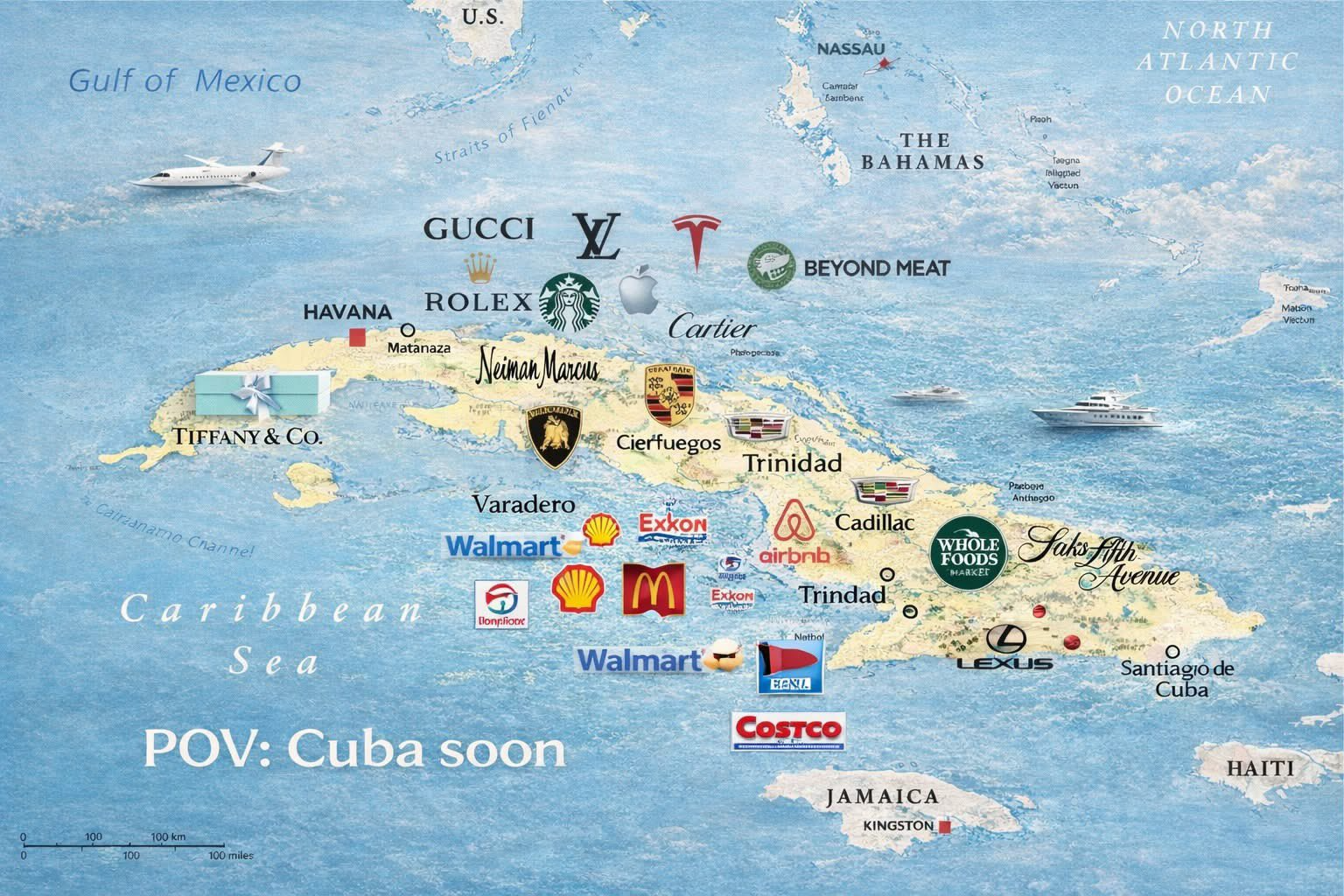
Featured Image: U.S. Republican Congressman Carlos Giménez, who is himself Cuban-American posted a photo of a map depicting what a post-communist, corporation-friendly Cuba could look like.
Image Credit: Rep. Carlos A. Gimenez via XLicense: Creative Commons Licenses