
Medellín, Colombia – On September 15, 61-year-old Gerardo Moreno Santana was murdered in a rural area of Planadas, Tolima, in central Colombia, making him the 12th signatory of Colombia’s 2016 peace agreement with the FARC to be killed so far in 2026.
Colombia’s Special Jurisdiction for Peace (JEP), the transitional justice mechanism set up by the peace accord, condemned the killing.
“The Special Jurisdiction for Peace categorically condemns the murder of Gerardo Moreno Santana—a Peace Agreement signatory appearing before the tribunal—which took place on September 15 in a rural area of Planadas, Tolima,” the JEP wrote on X.
The body added that Moreno had been “fulfilling his obligations to the Restorative Transitional Justice system as a participant representing the FARC-EP Joint Command in Case 10 of the JEP.” The proceeding, it said, investigates non-amnestiable crimes committed by the former guerrilla group.
Over 500 signatories have been assassinated since the peace agreement, which will celebrate its 10th anniversary in November. The JEP warned that “acts such as this one have a profound impact on the families and communities of peace accord signatories, and put at risk those who, through their reintegration process, contribute to the country’s truth, memory, and reconciliation.”
The JEP is tasked with investigating, clarifying, prosecuting and punishing the most serious crimes in Colombia’s half-century armed conflict. The body is set up to encourage former combatants to testify to their crimes in exchange for more lenient punishment.
Rights groups contest that the killings of signatories have gone relatively unpunished for years.
“Violence against signatories is structural,” Francisco Daza, a spokesperson for the Peace and Reconciliation Foundation (Fundación Paz y Reconciliación – PARES), told The Bogotá Post. “No government, so to speak, has really addressed it, much like the violence against human rights defenders.”
Daza said that in killings involving peace agreement signatories, social leaders and human rights defenders, “the perpetrator is unknown in 70 to 80 percent of cases.” In other words, he said, “there is also a system of impunity that does not help create effective mechanisms for prevention.”
Colombia’s peace deal with the FARC began on rocky ground. A plebiscite to approve the agreement was narrowly voted down before then-President Juan Manuel Santos pushed a revised deal through Congress in 2016. Since then, the peace process has received various levels of cooperation from the government depending on who is in power, and Colombia’s current president, Abelardo de la Espriella, has threatened to dismantle the JEP altogether.
Alexander Monroy, co-founder of La Trocha – La Casa de la Paz, one of over 6,000 economic reintegration projects for peace signatories in the country, the state of the peace agreement is critical.
“I feel that there is a violent rhetoric and, at this point, even a policy coming from the state,” Monroy told The Bogotá Post. “The issue is the state’s failure to recognize the peace agreement, combined with this violent rhetoric—rhetoric that, obviously, stigmatizes us and once again singles us out.”
In August, de la Espriella announced he would end all peace negotiations with armed groups that began during former President Gustavo Petro’s “Total Peace” plan.
Read more: Abelardo de la Espriella begins to dismantle Colombia’s peace process
And his opposition to peace talks has been felt in other areas as well. The Agency for Reincorporation and Normalization (ARN), which supports the reintegration and reincorporation processes of former combatants, will reportedly face a 37% budget cut in 2027.
It also affects the National Land Agency, which is estimated to face a 71.8% reduction in its resources, as well as the Territorial Renewal Agency.
The JEP’s president, Alejandro Ramelli Arteaga, warned of potential funding cuts of 100 billion Colombian pesos (approximately US$31.2 million) as a result of bills introduced by governing parties and supported by President de la Espriella.
“There is evidence of a strategy aimed at preventing the JEP from functioning,” Ramelli Arteaga said.
The magistrate also said that they recognize the fiscal crisis facing the judiciary, but that it should not be resolved at the expense of transitional justice, as this would put at risk the rights of victims and the legal certainty of those appearing before the JEP.
For Daza, peace faces significant challenges given the current landscape. Nevertheless, he believes there is reason to remain hopeful, arguing that if the past 10 years of implementation have left anything behind, it is the territorial organizational experiences throughout the country that have contributed to peacebuilding.
“They show that peace is possible and that Colombian society needs this kind of peace – a peace achieved through agreements and negotiations, rather than one produced by war, because history has already shown us that war is not the way forward and has never worked,” the PARES spokesman said.
Monroy adds that peace has brought greater benefits to the country in terms of the economy, tourism, education, land access, and political participation. He warned that abandoning the peace process could set the country back years, revive conflict, and undermine political, social, and economic progress.
“This community continues to believe in this process. And I think that is precisely why it is not only worthwhile, but also our duty to continue promoting and supporting those who are committed to peace in the country,” Daza said.
According to Alejandra Miller, director of the Agency for Reincorporation and Normalization (ARN), 85% of former combatants—more than 11,000 of the 13,609 who laid down their arms in the demobilization process —remain engaged in the reincorporation process.
“We have to remain persistent in this. We have to keep going, right? As [former Uruguayan President] Pepe [Mujica] used to say, to stop fighting is to stop dreaming…I think we are convinced that peace is much better and that it serves us all better than waging war,” Monroy said.
“I deeply believe in unity. We have to come together—all of us who believe in peace and in building a different country.”
This article originally appeared on The Bogotá Post and was republished with permission.
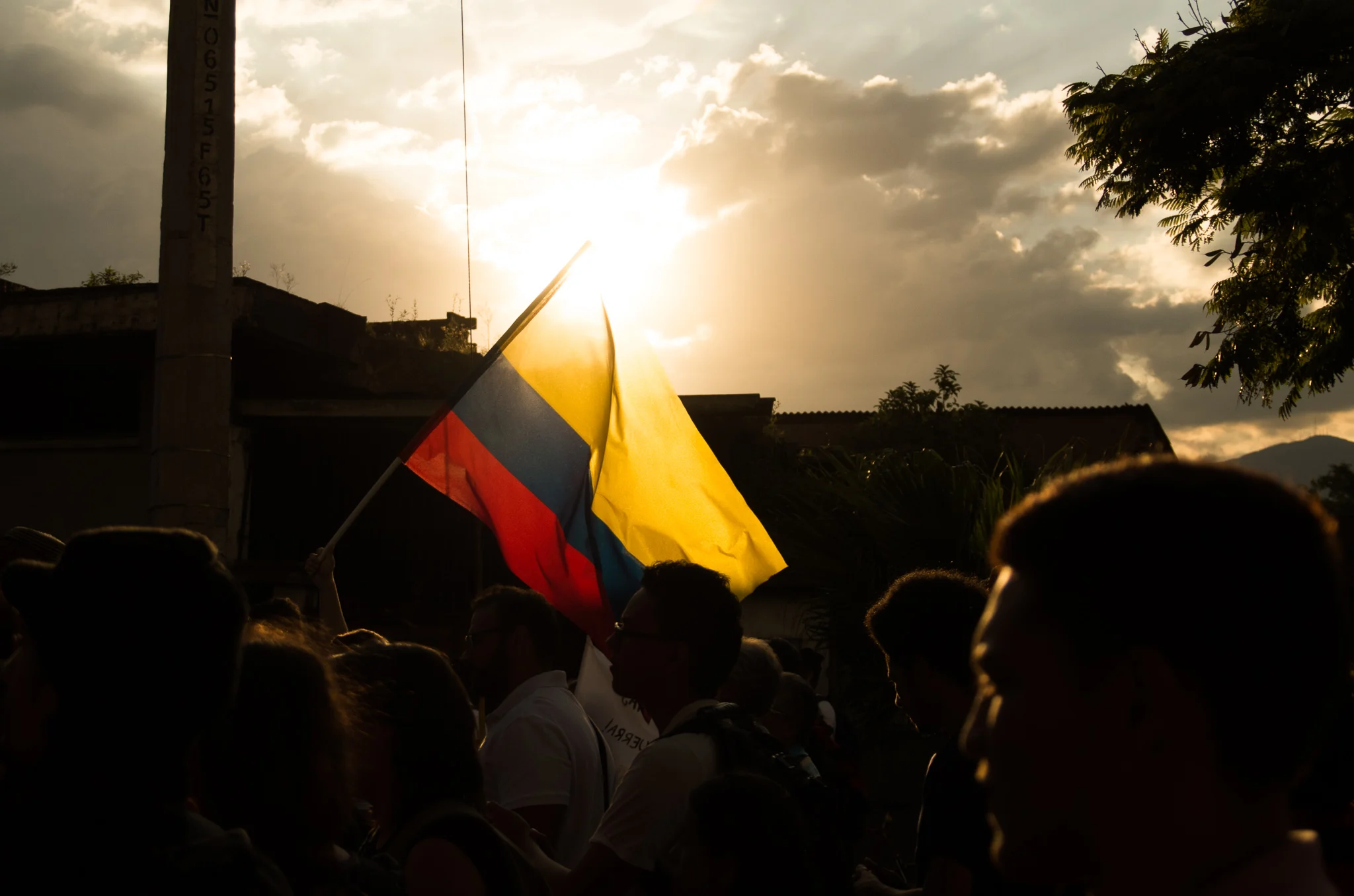
Featured image description: Colombian flag
Featured image credit: Leon Hernandez