

A group of protestors attacked an office of the ruling Cuban Communist Party (PCC) in the central Cuban city of Morón on Saturday, with five of the protestors allegedly detained by the Cuban authorities.
Demonstrations in the city began late on Friday and were initially peaceful, with calls for an end to power cuts and food shortages. However, the protests appeared to escalate throughout the night, as videos shared on social media showed the Communist Party office being ransacked – computers, documents and furniture were removed from the building and subsequently burned in the middle of the street.
Protests have started occurring with greater frequency on the authoritarian-run island as it faces a U.S-imposed oil blockade; earlier this month power outages caused frustrated Cubans to take to the streets in the major cities of Havana and Matanzas.
The Morón demonstrations occurred shortly after Cuban President Miguel Díaz-Canel announced that the Cuban and American governments are engaged in diplomatic negotiations to de-escalate tensions between the two countries and end the current U.S. oil blockade of the nation, the driving factor behind the current economic crisis.
Although the increasingly frequent protests have been primarily caused by the power outages, some protestors have used the demonstrations as an opportunity to call for an end to the PCC’s one-party rule of the island.
Chants of “patria y vida” – a famous anti-regime slogan meaning “homeland and life” – and “abajo la dictadura” (down with the dictatorship) were reportedly heard at the Morón demonstrations.
Some videos also appear to show protestors in Morón throwing rocks at police and PCC officials, forcing them to flee. Independent Cuban journalist Guillermo Rodríguez-Sánchez reported that the police retaliated against the protestors; a Cuban police officer allegedly fired his sidearm, hitting a protester in the thigh.
Much of this information remains unverified as the incident occurred during an internet outage in the region.
Responding to the protest, Cuban President Miguel Díaz-Canel posted on X that the “Discontent provoked amongst our people by the prolonged blackouts is comprehensible … [and] the complaints and grievances are legitimate”.
He warned, however, that “what will never be comprehensible, justified or admitted is violence”.
A Cuban functionary, who asked to remain anonymous, told Latin America Reports that the protests were caused in part by “logical displeasure by the population because of the [economic] situation”.
However, he also suggested that the protests were partly “orchestrated and promoted from Miami to cause violence. Those in Miami [the Cuban-American anti-communist lobby] are against dialogue and they want to force the United States to take military action”.
The functionary insisted that his stated opinion was personal and not representative of the Cuban government. Various prominent Florida-based Cuban Americans who oppose the Cuban regime, such as Congressman Carlos Giménez, voiced their support for the Morón protests.
Giménez’s statements are consistent with a history of large sections of the Cuban-American diaspora calling for, and supporting attempts to force, regime change on the island.
Recently, 10 armed Cubans resident in the U.S. allegedly attempted to infiltrate Cuba on a Florida-registered speedboat with the hopes of destabilizing the communist government.
The mission to infiltrate Cuba was allegedly associated with the People’s Self-Defense Forces, a Cuban opposition organization that promotes clandestine armed action against the Havana government and whose leader resides in Miami.
Like the unnamed Cuban functionary, Díaz-Canel also laid the blame for the power shortages, and the consequent protests, at the hands of the “energy blockade of the United States, which has been cruelly intensified in the last few months”.
The American blockade of foreign oil imports to the communist-run island countrywide has indeed led to chronic fuel and electricity shortages. No foreign fuel supplies have entered Cuba in the last 3 months.
According to experts, Cuba needs approximately 110,000 oil barrels of oil a day to maintain basic services. Domestically, the Latin American nation is able to produce a mere 40,000 daily barrels.
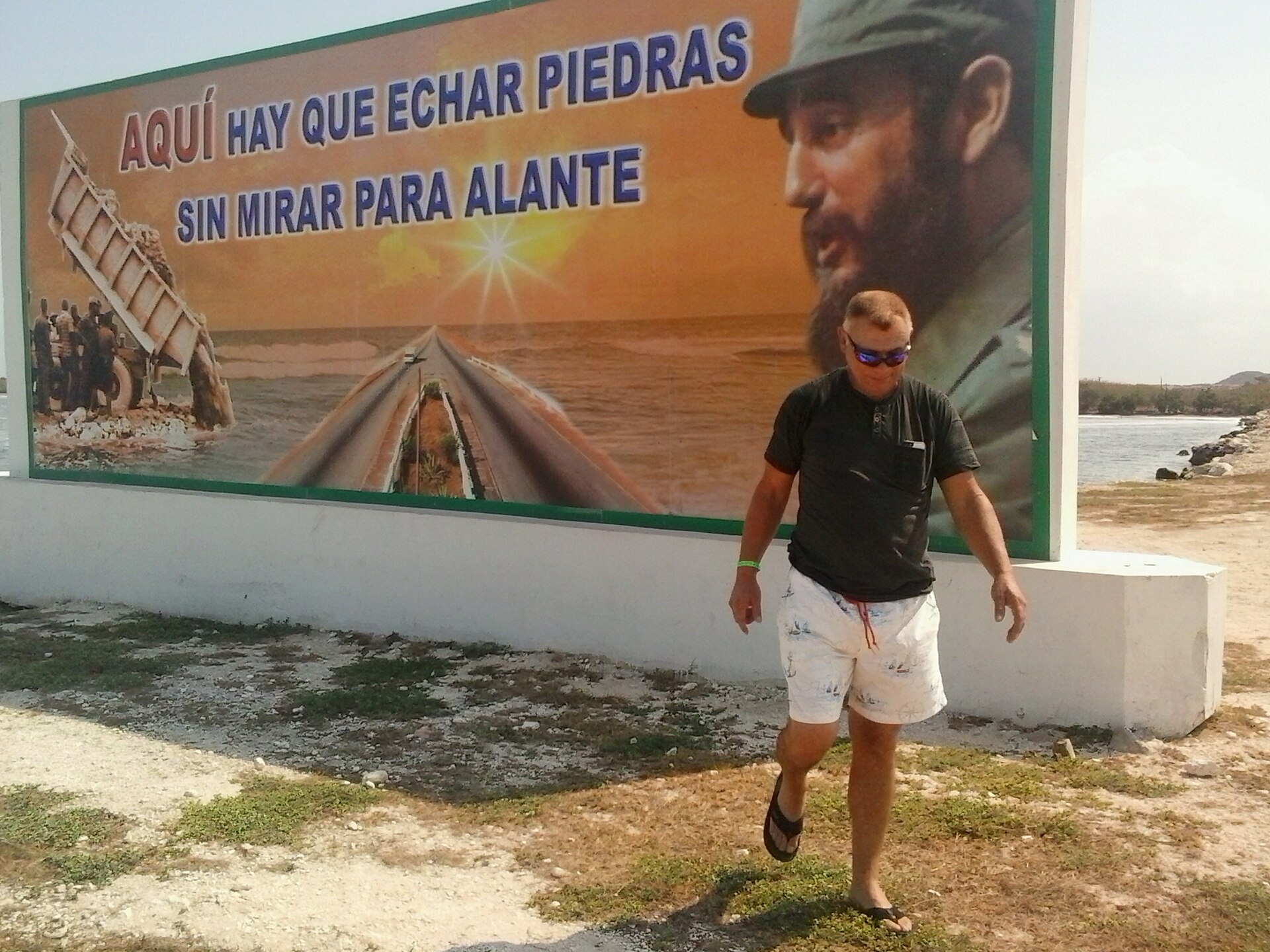
Featured Image: A pro-regime mural in Morón, the site of the most recent protests. The mural shows late Cuban revolutionary leader Fidel Castro.
Image Credit: Carlos Adan via Wikimedia Commons
License: Creative Commons Licenses

.jpg)