
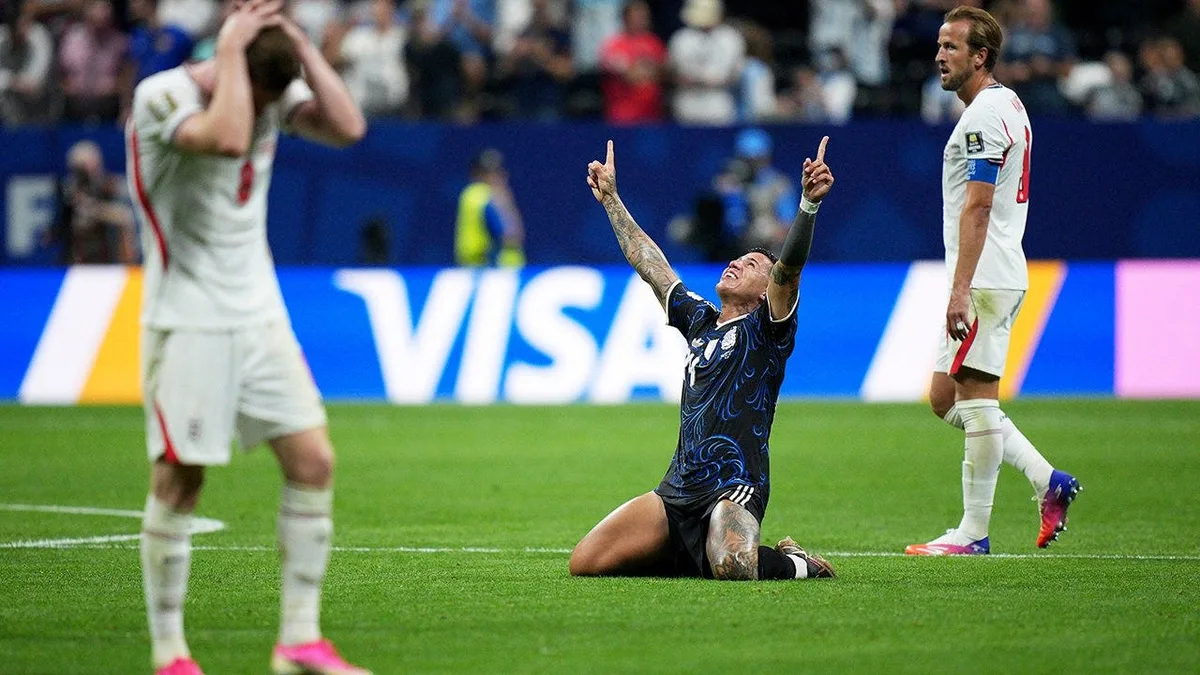
Following Argentina’s 2-1 victory over England in Wednesday’s World Cup semi-final, several Argentina players held up a banner proclaiming “The Malvina (Falkland) Islands are Argentine”.
UK Prime Minister Keir Starmer has since condemned the display, with his government calling on FIFA to investigate.
The incident has not only reignited debate about the ownership of the islands – claimed by both the UK and Argentina – but also raised questions about the role of politics in the World Cup.
History of the Falklands thrust back into the spotlight
Located approximately 500 kilometres off Argentina’s coast and known to the British as the Falkland Islands and the Argentines as the Malvinas, the islands remain a UK territory but are claimed by Argentina.
The Falklands Islands, under British control since 1833, were seized by the forces of the Argentine military junta in April 1982. In response, a British naval task force was dispatched to the South Atlantic by then UK Prime Minister Margaret Thatcher.
The task force engaged the Argentine military and defeated them. In the conflict, 907 people died, including 3 Falkland islanders, 255 Britons and 649 Argentines.
Since the war, Argentina has not dropped its claims to the islands but tensions have largely, although not entirely, cooled. In a 2013 referendum on the political status of the islands, 99.8% of islanders voted to remain a British overseas territory.
But the status of the islands remains a contentious issue for current Argentine and British administrations; the incumbent Argentine President Javier Milei posted on X yesterday that Argentina was getting closer to “recover[ing] the Malvinas Islands”.
However, Milei has also previously said that his nation does not “seek conflict” over the issue.
Meanwhile, Prime Minister Starmer maintained Britain’s claim over the territory after Wednesday’s match.
“The World Cup might not be ours, but the Falkland Islands definitely are. Our position is unchanged. Self-determination rests with the islanders and our commitment to the Falklands will never waver,” said a spokesperson for Starmer on Thursday.
The islands continue to be a flashpoint between the two governments.
Just hours after the World Cup victory for Argentina, the Argentine Foreign Minister Pablo Quirno accused British warship HMS Medway of not notifying local authorities before it entered Argentine waters, which Quirno described as a “military incursion”.
The British Ministry of Defence, in response, rejected these accusations and Starmer’s spokesperson has said that the ship was on a “routine logistics visit to Chile”.
Dr Matt Benwell, Associate Professor of Human Geography at Newcastle University and specialist in the geopolitics of the South Atlantic, contextualized the political controversy surrounding the banner in conversation with Latin America Reports.
The academic disputed the notion that the controversy surrounding the banner reflects either resurgent nationalism on either side or an increased potential for conflict. Instead, he clarified that the actions of both the British and Argentine sides have by and large been predictable.
“For Argentines, the phrase ‘Las Malvinas son Argentinas’ is a part of everyday life displayed on public transport, murals, monuments, and repeated by politicians and other public figures regularly, as a reminder of Argentina’s sovereignty claim,” Benwell argued.
The academic pointed out that the players’ display of the banner in front of their fans was therefore no emblem of resurgent nationalism, but also stressed that the Argentine footballers would have been aware of the potential punishment by FIFA.
“To that end it’s simply not seen as provocative in Argentina given its everyday presence. It’s when you take that to the global stage and the FIFA World Cup that has very strict rules about political expression and sporting competition that this becomes controversial and provocative”, Benwell continued.
Starmer’s response, Benwell asserted, was just as predictable.
“Starmer calling for an investigation is to be expected given the high-profile nature of the incident and the clear regulations that are set out by FIFA.”
“The waving of a banner declaring sovereignty over the Falkland Islands simply could not go unchecked given he would have received heat from veterans of the Falklands War, the Falkland Islands Government and islanders themselves if this had gone without comment,” the geographer concluded.
Will the Argentina team face punishment?
Starmer’s Business Secretary Peter Kyle, has called for an investigation into the banner display on Wednesday.
“We expect FIFA to undertake an investigation into this. I think it was … such an egregious violation of the rules of not having political activity as part of the football,” Kyle told Sky News.
The banner was held up by several Argentina players, including River Plate’s Nicolás Otamendi, Manchester United’s Lisandro Martínez and Real Betis’s Giovani Lo Celso, after a heated clash between the two national teams in Atlanta.
England opened the scoring after 55 minutes but Argentina responded in kind with two goals after the 80th minute, with Argentine superstar forward Lionel Messi providing both of the assists.
Disciplinary action over the kind of sloganeering seen after the semi-final on Wednesday is not unprecedented: in 2014, FIFA fined the Argentine Football Association (FA) £20,000 after the national team had shown a banner with the exact same wording before a friendly match against Slovenia.
The FIFA stadium code of conduct for the 2026 World Cup includes the following in its list of prohibited items: “any materials, including but not limited to banners, flags, fliers, apparel and other paraphernalia, that are of a political … nature”.
FIFA has not yet indicated if it is pursuing action, instead declaring that it is “assessing match reports” before making any decision on punitive action. It is also unclear whether the English Football Association will seek to file a complaint.
Also Read: Argentina against the world: Rivalries, conspiracies, and social media fuel World Cup divide
Argentina’s victory means they will face Spain in the World Cup final on Sunday.
Featured Image: Argentina player Enzo Fernández celebrates as England’s Harry Kane and Elliot Anderson despair after Argentina’s 2-1 win against England.
Image Credit: Printscreen/Social Media via Srpske Novine
License: Creative Commons Licenses