
A majority of UN member countries voted for the 34th time to condemn U.S. economic sanctions against Cuba today.
Cuba brought its annual non-binding resolution, which it first presented to the assembly in 1992, to the UN General Assembly (UNGA) on Tuesday. The resolution, entitled “Necessity of Ending the Economic, Commercial and Financial Blockade Imposed by the United States of America Against Cuba”, once again passed convincingly in today’s vote.
This year, 130 countries voted in favor of the resolution, 17 voted against and 25 abstained.
Despite the continued international condemnation of the measures, the number of countries siding with the U.S. has increased noticeably in recent years.
Last year, 165 countries voted for the resolution, while only six nations joined Washington in voting against the resolution, with a further twelve abstaining. By contrast, in 2024, the only countries opposing the resolution were Israel and the U.S., and only Moldova abstained.
In the buildup to the debate Cuban Foreign Minister Bruno Rodríguez Parrilla said that the vote would show how “every country … demonstrate[s] how they view justice and courage,” arguing that the “blockade” – the Cuban government’s name for the sanctions – was a “threat.”
U.S. Ambassador to the UN Mike Waltz told member nations that “your vote today is the only thing standing between the corrupt kleptocratic communist regime … using this body and your vote for another propaganda victory at the expense of the Cuban people.”
Cuba had previously accused the U.S. of conducting a large-scale international diplomatic campaign to pressure countries to vote against Cuba, or at the very least abstain, at today’s UN vote.
Cuban Foreign Minister Bruno Rodríguez Parrilla claimed on October 21 that U.S. “persuasion methods” included “threats against governments to impose punitive tariffs, suspend cooperation programs, deny visas to government officials and their families, support opposition forces in upcoming elections, and even politically destabilize the countries.”
“They have gone to the ridiculous extreme of proposing that certain countries abstain or, as a last resort, absent themselves from the vote, if they cannot manage a vote against Cuba,” Cuba’s top diplomat alleged.
The context behind the vote
The U.S. has maintained economic sanctions against the Caribbean island nation for over six decades.
In February 1962, then-U.S. President John Kennedy announced a comprehensive economic, financial and commercial embargo on trade between the U.S. and Cuba as relations between Washington and the new communist revolutionary government in Havana deteriorated.
In the 1990s, sanctions were hardened with new legislation that made American sanctions extraterritorial, punishing (non-U.S.) foreign companies with commercial links to Cuba. The new laws made lifting the sanctions conditional on political change and a democratic transition in Cuba.
This year, tensions between Washington and Havana have re-emerged with a vengeance.
The Trump administration has effectively severed the Cuban-Venezuelan alliance, which has meant that Cuba has lost its significant oil supply from Caracas, imposed a near-total oil blockade on the island, sanctioned essential Cuban industries and repeatedly threatened to conduct a military regime change operation against the Cuban political leadership.
These tensions were reflected in the debate leading up to the UNGA resolution, as Cuban Foreign Minister Bruno Rodríguez Parrilla and U.S. Ambassador to the UN Mike Waltz engaged in a shouting match on Tuesday as Waltz made a speech encouraging member states to vote against the resolution condemning the U.S. sanctions regime.
Read more: Tensions erupt between Cuban and U.S. diplomats before key UN vote
While Waltz was accusing the Cuban government of corruption and stealing the popular wealth of the Cuban people and scapegoating the U.S. embargo for widespread Cuban poverty, the Cuban diplomat called Waltz a “liar” and said he was “beneath the dignity of this [the UNGA] forum.”
In response, Waltz told the Cuban diplomat to “back up” and reprimanded him for supposedly treating the assembly as if he were in the “communist dictatorship” in Havana.
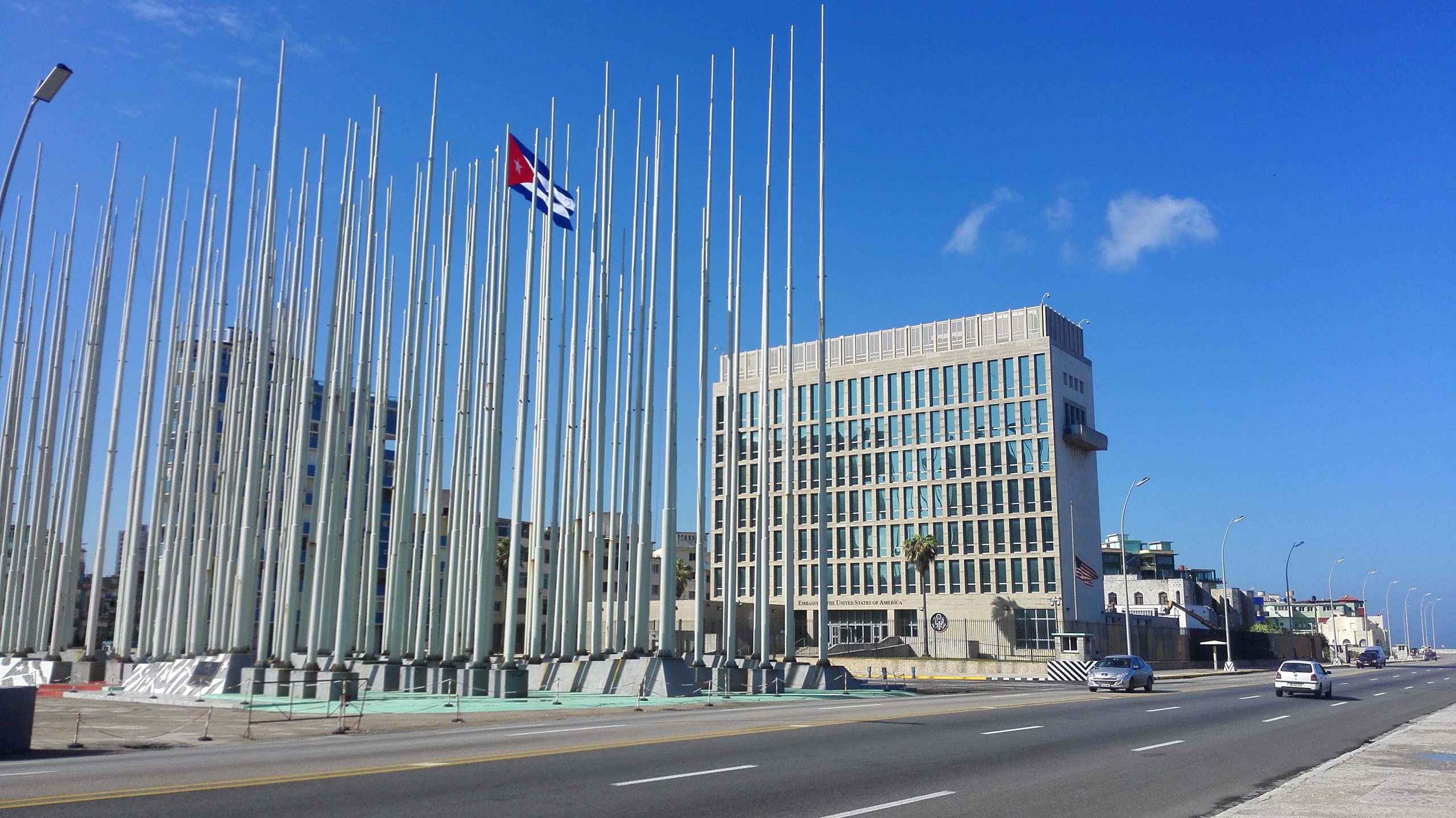
Featured Image: The U.S. embassy in Havana.
Image Credit: RG72 via Wikimedia Commons
License: Creative Commons Licenses