
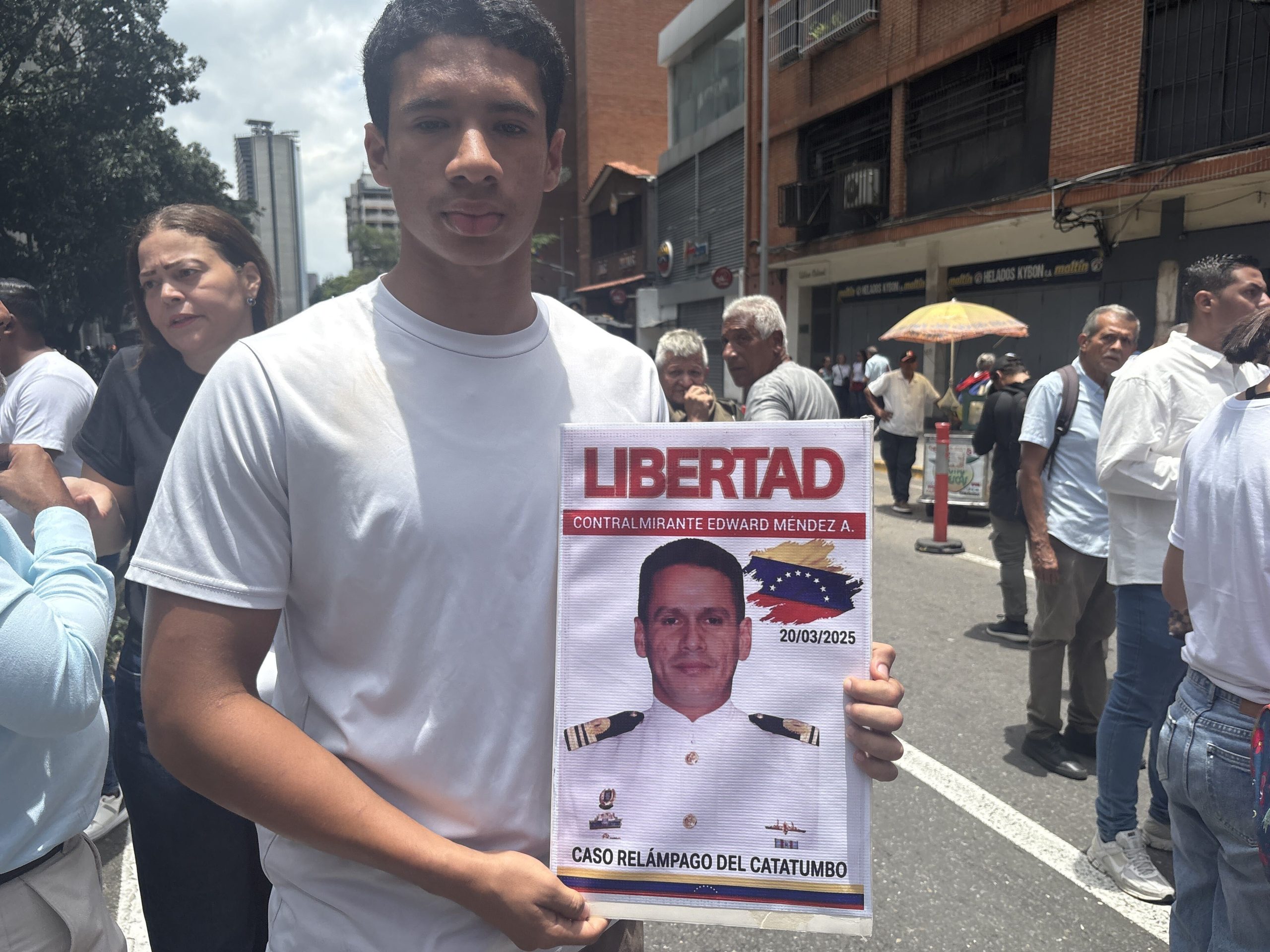
Caracas, Venezuela – For almost a year and a half, 19-year-old Edward Alejandro Méndez has been unable to see his father.
The Venezuelan military officer has been in prison since March 2025. He is allowed visitors every two weeks, but Edward cannot go. The prison where his dad is held only allows visits from females.
Edward remembers the ordinary moments they used to share: playing basketball and football, or going for a run together.
“I miss my father terribly,” he told Latin America Reports. “He is a very principled and honest person, and that is something I admire deeply. It is not just me who admires him, but many members of our family and many people who know him. Those are the things that leave a mark, that stay with you.”
Edward Méndez Araujo was commander of the main Coast Guard station in Maracaibo and had been assigned to Operation Catatumbo Lightning, a government operation targeting drug, arms and fuel trafficking around Lake Maracaibo.
But he was arrested in March 2025 in connection with charges including terrorism, drugs and arms trafficking.
Others were arrested too, and the government also accused opposition figures including María Corina Machado, Juan Pablo Guanipa and Edmundo González of links to the wider operation.
Edward’s family disputes the accusations.
“We still have not been allowed to see the case file to find out what the supposed evidence is, or what facts or actions they are relying on to accuse him of these crimes,” he said.
For nearly three decades, Venezuela has been ruled by Chavista governments. Under Chavismo, the political movement that emerged around the late Hugo Chávez, the country has seen an erosion of democratic institutions, alongside allegations of corruption and widespread human rights abuses.
The justice system has also faced longstanding concerns over its independence and due process, with hundreds of people classified as political prisoners, including people detained for political reasons or in cases involving serious violations of their rights.
One of the hardest parts, Edward says, is knowing his father is missing the chance to watch his children grow up. His family has told his youngest sister that her father is working and will be home soon.
On New Year’s Day, his father managed to make a call after someone lent him a phone. When it was his sister’s turn to speak to him, she asked when he was coming home because she missed him.
“I remember my father telling her that he would be home soon. I’m sure he said it with a lump in his throat,” Edward said. “I couldn’t hold back my tears because I couldn’t believe we were living through this reality.”
As Edward has been dealing with his father’s imprisonment, he has also recently been grieving the death of his girlfriend.
Louismar was also 19 when she died in the twin earthquakes on June 24.
Edward had seen her the day before. They studied physiotherapy together and had gone to classes, then spent time together before going home. The following afternoon as they were chatting just minutes before the earthquakes, she sent him two photographs of them together.
“Those two photos are not just memories I carry in my mind or in my brain, but in my heart, because to me they were her final farewell messages,” he says. “They mean so much to me because in those photos we are both happy.”
After the earthquakes, Edward couldn’t get through to her. He went to the building where she lived in Caraballeda. “I was looking for her using a photograph. I found a photo on my phone and showed it to every person I came across, asking whether they knew her, whether they had seen her.”
Edward became increasingly angry at the government’s response, saying it took around 20 days for machinery and the military to arrive in greater numbers. It was ordinary Venezuelans, like himself, that were scouring the rubble for survivors – and then bodies.
After 31 days, he found Louismar and, with others, pulled her body from the rubble with his own hands.
“Sitting down afterwards, having pulled her body out and seeing her in front of me inside a body bag, was like reality hitting me in the face. That was when I burst into tears,” he said.
With his girlfriend dead and his father in prison, Edward says he feels “paralyzed” – and uncertain about his future.
But he also feels angry.
At a demonstration in central Caracas at the end of August against political prisoners still in jail, a video of Edward speaking to Latin America Reports went viral after he criticised the police and the state.
“They’re here repressing us, violating human rights. Now they’re here, but on June 24, two months ago, they didn’t come. I, with my fingernails and my own hands, pulled my girlfriend’s body out from under the rubble,” he said.
In a later interview, he told Latin America Reports that he felt frustrated when he saw the heavy police presence because the state’s response had been so slow in the aftermath of the earthquake.
Political protests have increased since Nicolás Maduro’s capture on January 3 by U.S. Special Forces, with many citizens saying they feel there has been an easing of repression. But many, like Edward, still don’t believe the changes in the country go far enough.
Political talks are now under way between the government and part of the opposition over Venezuela’s political future, including changes to its institutions. For Edward, reforming the judicial system is one of the priorities.
“We need the courts to act autonomously and for the system to genuinely guarantee that the laws are upheld,” he said, adding that basic rights need to be respected. This includes detainees being able to choose their own lawyer, see their case file, have their families kept informed and know the facts they are being accused of.
He hopes the ongoing protests and political talks can lead to changes that will eventually allow his father to come home. Louismar, he knows, does not have that chance.
At 19, Edward is trying to work out what kind of future is left for him, and for a country he has never known without Chavismo.
“For me, the only thing I want is for things to be moving towards the common good, for the outcome of all this to be peace for the people. And that is achieved by putting justice and truth first.”
Featured image description: Edward Alejandro Méndez holds a picture of his father at a protest in Caracas.
Featured image credit: Catherine Ellis