

Guaviare, Colombia – As Colombians head to a run-off vote on Sunday, 21 June to elect their next president, a leading think tank warns the next leader will inherit a cross-border security crisis with Ecuador that neither country can resolve alone.
A report from the Royal United Services Institute (RUSI) says fragmentation of armed groups in Colombia, alongside competition over illicit economies, has worsened instability and insecurity on both sides of the border.
Today, Ecuador and Colombia now have a much more integrated criminal ecosystem that Abelardo de la Espriella or Ivan Cepeda, the two presidential candidates in Sunday’s run-off, will have to confront.
“While Colombia’s long-held struggle with armed violence was something Ecuador previously experienced only at its periphery, the country now faces a similar security predicament as its neighbour,” Jennifer Scotland, co-author of the RUSI analysis, told Latin America Reports.
“Decentralized organised crime groups have established control of strategic territories, captured state institutions and diversified into a range of illicit economies.”
The role of cocaine
One of these illicit economies is cocaine.
Sandwiched between Colombia and Peru, two major coca-producing countries, Ecuador has historically played only a limited role in the cocaine economy, while Colombia remains the world’s largest producer, accounting for up to two thirds of coca production.
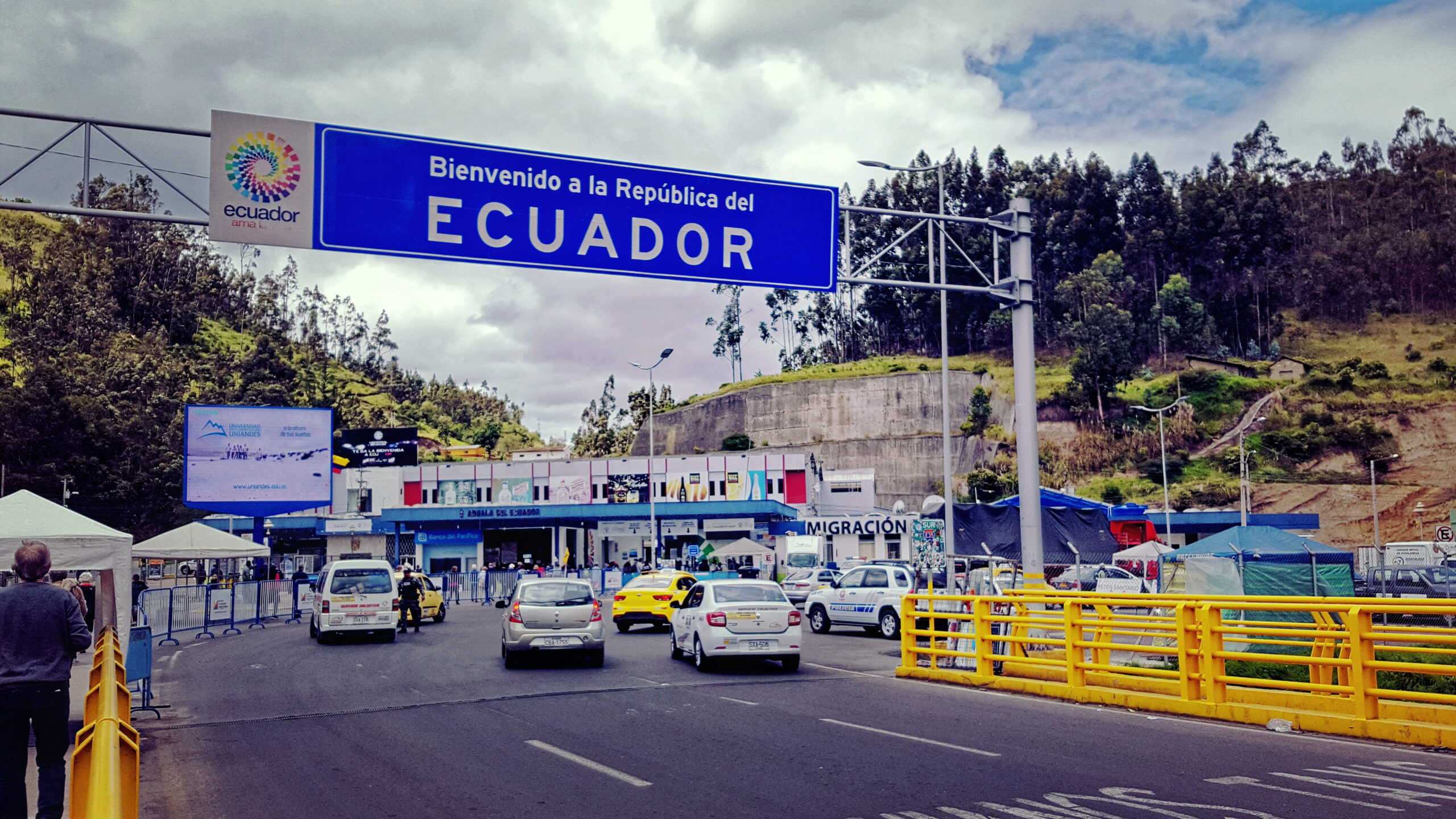
But the report says Ecuador has become increasingly entangled in trafficking flows. A porous 600km land border with Colombia and access to the Pacific have helped make Ecuador a key transit route for cocaine trafficking.
From 2019 to 2024, cocaine seizures at Ecuadorian ports rose by 4,817%, from six tonnes to 295 tonnes.
Around 30% of cocaine seized globally in shipping containers in 2023–24 originated from Ecuadorian ports.
For Europe, the proportion was even higher. Ecuador is now a primary gateway into Europe’s cocaine supply chain.
“Ecuador’s transition to a central hub for global cocaine trafficking routes is the result of Ecuador’s lack of preparedness to deal with the threat, coupled with a reconfiguration of criminal dynamics in neighbouring Colombia,” Scotland said.
The spillover effects from shifts in Colombia’s organized crime dynamics have transformed Ecuador from “a peripheral player into a central export hub in global cocaine supply chains,” according to the report.
The Root of the Cross-Border Security Crisis
The root of this, according to the RUSI briefing, goes back to the 2016 peace accord between the Colombian government and the FARC.
The demobilisation of the FARC “reconfigured the landscape”, with former combatants splintering into dissident groups while new and existing armed actors moved to fill the vacuum.
Nearly a decade later, the effects are being felt on both sides of the Colombia-Ecuador border.
This fragmentation reshaped Colombia’s cocaine economy, with competition over supply routes and production zones giving rise to a decentralized model based around a “system of ‘service providers’”, with different groups managing each stage of the supply chain.
By 2023, 65% of Colombia’s coca crops were concentrated in just three departments, including Nariño and Putumayo on the Ecuador border, and Norte de Santander on the Venezuelan border.
In these border regions, a “hyper-competitive criminal ecosystem” has emerged, as rival groups – including FARC dissident factions and other armed actors – compete for control of coca-producing areas and trafficking routes towards Ecuador and the Pacific coast.
Drivers of Violence
Once considered one of the safest countries in South America, Ecuador recorded its most violent year on record in 2025, with a homicide rate of 51 per 100,000 inhabitants.
The analysis links the rise in violence to Ecuador’s growing integration into regional cocaine trafficking networks and longstanding institutional weaknesses.
According to the findings, criminal groups in Ecuador have become more assertive and insurgent-like, adopting tactics similar to armed groups in Colombia and Mexico. These include car bombings, assassinations of journalists, security officials and politicians, including the 2023 killing of presidential candidate Fernando Villavicencio, as well as coordinated attacks such as prison riots and a TV station takeover in January 2024.
“This evolution and entrenchment of Ecuador’s organised crime groups – and the unprecedented violence that has accompanied them – has exposed deep structural weaknesses in Ecuador,” the report highlighted.
A Need for Increased Bilateral Cooperation
While Colombia and Ecuador have official channels for cooperation on border security, including joint operations and information sharing, the briefing says these efforts are irregular and largely focused on short-term arrests rather than longer-term strategies.
RUSI says these limitations are compounded by deep ideological differences and a strained relationship between the two governments, highlighted in early 2026 by a tit-for-tat trade war between Colombia’s left-wing leader Petro and Ecuador’s right-wing President Noboa.
Furthermore, Colombia has emphasized negotiations with armed groups under its “Total Peace” policy and Ecuador’s more militarized approach focused on security crackdowns and high-value arrests.
“Despite these shared, interlinked experiences, meaningful bilateral cooperation between the two countries has been blunted by stark ideological differences, leaving each side to deal with the threat in their own way,” said Scotland.
“To tackle this threat more effectively, both countries will need to work together more purposefully. This will require looking past reactive, unilateral responses and considering more holistic, coordinated strategies that focus on the drivers, not just the symptoms, of cross-border illicit activity.”
Its recommendations include establishing a Joint Intelligence and Operations Center to enable real-time data sharing, and a structured capacity-building programme for security forces, promoting two way knowledge sharing on counternarcotics, cyber intelligence and port security. It also urges building trust by engaging youth and underrepresented communities.
With Colombia’s election on Sunday 21 June likely to reshape the relationship, RUSI warns that continued inaction will carry a human cost on both sides of the border.
Featured image description: Colombia-Ecuador border photographed in 2020.
Featured image credit: Burkhard Mücke via Wikimedia Commons