
A new report published by the International Crisis Group (ICG) identified organized crime as a major obstacle to protecting the Amazon.
Criminal organizations have expanded territorial control in Brazil, Colombia, Venezuela, Ecuador, and Peru, with drug trafficking and illegal gold mining representing the main drivers of violence and deforestation across the region.
At the forefront of this expansion are the Indigenous communities inhabiting the Amazon, who are particularly vulnerable to lethal retaliation from criminal groups.
Below, Latin America Reports analyzes three key takeaways from the report.
Global economic patterns are driving the expansion of criminal groups
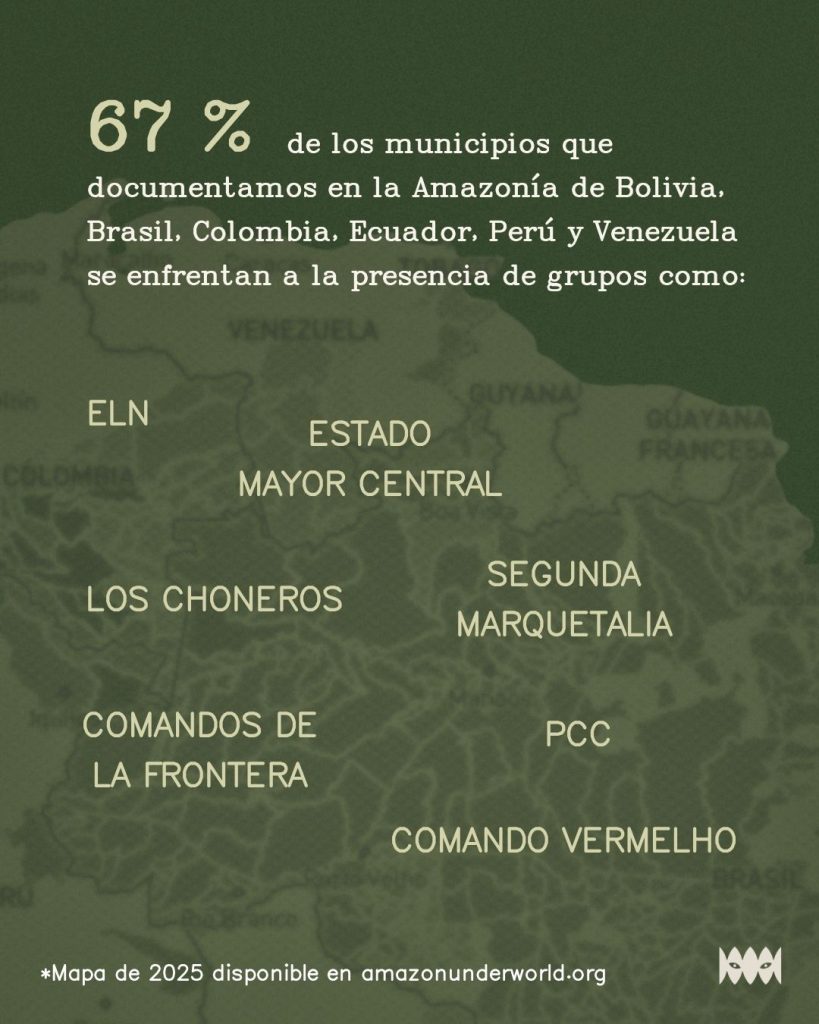
Organized crime groups are now present in at least 67% of Amazon municipalities in Colombia, Brazil, Venezuela, Peru, Ecuador, and Bolivia.
The report listed two main illicit activities behind this criminal expansion: shifting trends in global drug consumption and increasing demand for gold and other minerals.
Recent years have seen record levels of cocaine production in countries like Colombia, Bolivia, and Peru, while Europe has become the largest consumer market in the world. The increasing importance of Brazilian ports like Santos and Barcarena, as well as Guayaquil in Ecuador, as exit points for cocaine bound for Europe, has made the Amazon a central hub in drug trafficking routes.
Surging gold prices have made illegal mining increasingly attractive for criminal groups, and this trade is now more profitable than drug trafficking.
Some of the main criminal organizations operating in the Amazon include Brazil’s Primeiro Comando da Capital (PCC) and Comando Vermelho (Red Command), the Colombian National Liberation Army (ELN) and Comandos de la Frontera, and the Ecuadorian gangs Los Lobos and Los Choneros.
The growing influence of these groups is now prompting policy responses. In Brazil, the government has recently announced a $40 million fund to fight criminal factions in the Amazon and border regions.
Both cocaine production and illegal gold mining have devastating environmental impacts, relying on deforestation and generating harmful chemical waste through the use of substances such as mercury, cyanide, and hydrochloric acid.
In addition, organized crime reinvests its profits in activities such as industrial agriculture, land clearing, and cattle ranching, further fueling environmental degradation.
“Cocaine cannot be legalized, but meat and gold can, which is what makes them so attractive. Drug profits are reinvested in physical gold, mining equipment, land grabbing, and cattle acquisitions”, Bram Ebus, consultant at the International Crisis Group and founder of the journalism project Amazon Underworld, told Latin America Reports.
“Armed and criminal groups routinely use strawmen to control cattle herds, gold pawnshops, or mining operations. The endgame is always to penetrate the business world and co-opt political authorities”, Ebus added.
Indigenous communities are on the frontline
The ICG study highlights how Indigenous communities in the Amazon are the most exposed to criminal intrusion and violence.
In many of these countries, they constitute the frontline of territorial defense and monitoring. But the lack of coordination with – and distrust from – state authorities has made the role of Indigenous guards particularly risky.
Furthermore, armed groups coerce members of the communities into joining their ranks, either by force or with the promise of higher earnings from illicit activities.
“Rather than protecting the most vulnerable, in some cases state forces have assaulted local communities, who are too often framed as complicit in illicit economies rather than recognized as victims coerced into them”, said Ebus.
Ebus explained that the consequences also deeply affect Indigenous cultures, as local populations are often left with no viable alternative but gold mining, which destroys and contaminates their ancestral lands. Indigenous youth abandon traditional practices such as hunting and fishing, and become increasingly dependent on food supplies bought with income from the only available economic activity: illegal mining.
The violence can also be deadly. Criminal groups don’t hesitate to resort to lethal retaliation against those who oppose environmental exploitation or are suspected of collaborating with authorities.
Latin America is the region with the highest homicide rate in the world, and this statistic is even higher in the Amazon: between 2012 and 2024, a large share of the global murders of environmental and land defenders took place in this area. Colombia and Brazil alone made up 40% of the total number of deaths worldwide, with Indigenous peoples and members of Afro-descendant communities disproportionately affected by the violence.
An urgent need for coordination
The most urgent recommendation emerging from the study is the need to improve cross-border cooperation between Amazon states and to harmonize environmental laws.
“Amazon cooperation depends heavily on electoral outcomes this year in Brazil, Colombia, and Peru. The UNTOC assembly in October is another opportunity, with Brazil and Colombia, in particular, pushing for formal recognition of environmental crimes”, Ebus said.
The massive profits generated by illicit activities allow organized crime to corrupt authorities and capture state institutions, making intelligence sharing even more crucial.
Uneven regulations on environmental crimes enable criminals to exploit loopholes and weaknesses across different jurisdictions, especially where cross-border enforcement is lacking.
One example is the smuggling of mercury, a toxic substance used in the gold extraction process. All Amazon countries have signed the Minamata Convention, which restricts the sale and use of mercury, with Ecuador, Peru, and Colombia fully banning its import. In Bolivia, by contrast, the import and export of the element remain legal, and weak border controls have contributed to making the country a hub for the mercury trade in South America.
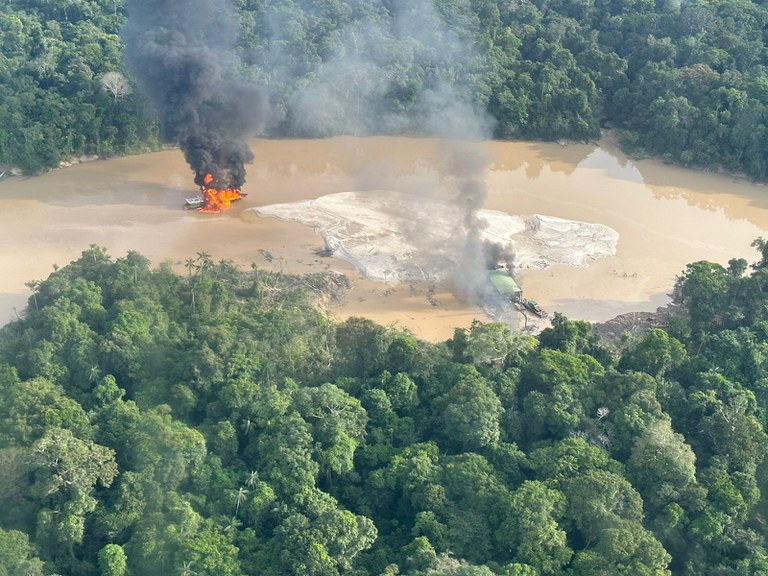
Featured image: Destroyed equipment of an illegal gold mine near the border between Brazil and Colombia.
Image credit: Federal Police of Brazil.